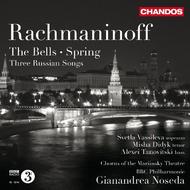
Rachmaninov - The Bells, Spring, Russian Songs
£15.15 £12.88
save £2.27 (15%)
special offer ending 01/01/2026
In stock - available for despatch within 1 working day
Despatch Information
This despatch estimate is based on information from both our own stock and the UK supplier's stock.
If ordering multiple items, we will aim to send everything together so the longest despatch estimate will apply to the complete order.
If you would rather receive certain items more quickly, please place them on a separate order.
If any unexpected delays occur, we will keep you informed of progress via email and not allow other items on the order to be held up.
If you would prefer to receive everything together regardless of any delay, please let us know via email.
Pre-orders will be despatched as close as possible to the release date.
Label: Chandos
Cat No: CHAN10706
Format: CD
Number of Discs: 1
Release Date: 31st October 2011
Contents
Artists
Svetla Vassileva (soprano)Misha Didyk (tenor)
Alexei Tanovitski (bass)
Chorus of the Mariinsky Theatre
BBC Philharmonic Orchestra
Conductor
Gianandrea NosedaWorks
Russian Songs (3), op.41Spring, op.20
The Bells, op.35
Artists
Svetla Vassileva (soprano)Misha Didyk (tenor)
Alexei Tanovitski (bass)
Chorus of the Mariinsky Theatre
BBC Philharmonic Orchestra
Conductor
Gianandrea NosedaAbout
Rachmaninov composed his ‘choral symphony’ The Bells in 1913. It takes its inspiration from poems by Edgar Allan Poe in a Russian translation by the poet Konstantin Balmont. The first movement, evoking the chimes of silver bells on a winter sleigh ride, is unusually cheerful for both the composer and author, while ‘Wedding Bells’ blends the yearning of Wagner’s Tristan und Isolde with a darker and more ominous undercurrent that carries through to the end. Of this Proms performance, The Guardian wrote: ‘The soloists soared, the choir bloomed, and Noseda powered the orchestra through thrilling climaxes to the funereal closing bars.’
In the brooding cantata Spring of 1902, the restlessness and lively use of percussion reflect the composer’s mindset at the time: he was hungry to write music once again after suffering from a three-year bout of writer’s block and depression. The work is based on a poem by Nikolay Nekrasov and describes the return of the Zelyoniy shum, or ‘green rustle’. The poem tells of a husband who, fraught with murderous thoughts towards his unfaithful wife during the winter season, is freed from his frustrations by the return of spring.
The Three Russian Songs are poignant, gem-like time capsules of a Russia now irretrievably lost. They were written in 1926 when Rachmaninov was living and exhaustively touring as a pianist in America. Vladimir Wilshaw, Rachmaninov’s old friend from student days, said of this work: ‘Only a man who loves his country could compose this way. Only a man who in his innermost soul is a Russian. Only Rachmaninov could have composed this!’
Error on this page? Let us know here
Need more information on this product? Click here