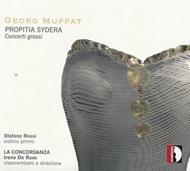
Muffat - Propitia Sydera: Concerti Grossi
£15.15
Currently out of stock at the UK suppliers. Available to order, but is likely to take longer than usual to despatch
Despatch Information
This despatch estimate is based on information from both our own stock and the UK supplier's stock.
If ordering multiple items, we will aim to send everything together so the longest despatch estimate will apply to the complete order.
If you would rather receive certain items more quickly, please place them on a separate order.
If any unexpected delays occur, we will keep you informed of progress via email and not allow other items on the order to be held up.
If you would prefer to receive everything together regardless of any delay, please let us know via email.
Pre-orders will be despatched as close as possible to the release date.
Label: Stradivarius
Cat No: STR33897
Format: CD
Number of Discs: 1
Genre: Chamber
Release Date: 3rd October 2011
Contents
Works
Concerto no.8 in F major 'Coronatio Augusta'Concerto no.9 in C minor 'Victoria Maesta'
Concerto no.11 in E minor 'Delirium Amoris'
Concerto no.12 in G major 'Propitia Sydera'
Violin Sonata
Artists
Stefano Rossi (violin)Irene de Ruvo (harpsichord)
La Concordanza
Conductor
Irene de RuvoWorks
Concerto no.8 in F major 'Coronatio Augusta'Concerto no.9 in C minor 'Victoria Maesta'
Concerto no.11 in E minor 'Delirium Amoris'
Concerto no.12 in G major 'Propitia Sydera'
Violin Sonata
Artists
Stefano Rossi (violin)Irene de Ruvo (harpsichord)
La Concordanza
Conductor
Irene de RuvoAbout
Muffat’s Concerti Grossi were thus first inspired in Italy, in the Roman literary salons in which Corelli and Pasquini used to perform. In particular, they were inspired by the Church and Chamber sonate à tre composed and most probably performed in Rome by Corelli. The 1701 preface contains just as much information on the performance practice and concertation: these indications tell us how freely the number of parts were considered, always depending on the number of performers and therefore whether or not the parts could be doubled. Muffat also tells us of the composition of his concertino, a group of chosen performers that may also include wind instruments. However, the use of winds together with strings tells us more about the author’s aesthetical taste and more generally about baroque and tone variety: they contrast and juxtapose strings in a dialogue and an ever new and different collision.
In the present recording the basso continuo is realized using harpsichord, harp, cello and violone following the indications for variety and full-bodied sound, both for the tutti and for the soli.
The CD includes also the Sonata for violin solo, which has an extremely free formal structure, incredibly original, in the Italian manner, alternating melodic movements (theme), rhythms (allegro fugato) and sections in a stylus phantasticus (adagio).
Error on this page? Let us know here
Need more information on this product? Click here