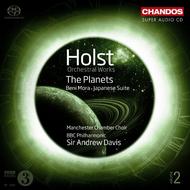
Holst - Orchestral Works Vol.2
£15.15 £12.88
save £2.27 (15%)
special offer ending 01/01/2026
In stock - available for despatch within 1 working day
Despatch Information
This despatch estimate is based on information from both our own stock and the UK supplier's stock.
If ordering multiple items, we will aim to send everything together so the longest despatch estimate will apply to the complete order.
If you would rather receive certain items more quickly, please place them on a separate order.
If any unexpected delays occur, we will keep you informed of progress via email and not allow other items on the order to be held up.
If you would prefer to receive everything together regardless of any delay, please let us know via email.
Pre-orders will be despatched as close as possible to the release date.
Label: Chandos
Cat No: CHSA5086
Format: Hybrid SACD
Number of Discs: 1
Release Date: 31st January 2011
Contents
Artists
Manchester Chamber ChoirBBC Philharmonic Orchestra
Conductor
Sir Andrew DavisWorks
Beni Mora (Oriental Suite), op.29 no.1Japanese Suite, op.33
The Planets, op.32
Artists
Manchester Chamber ChoirBBC Philharmonic Orchestra
Conductor
Sir Andrew DavisAbout
In this second volume, exclusive Chandos artist Sir Andrew Davis has taken the baton, conducting the BBC Philharmonic in a unique programme: The Planets, Holst’s orchestral tour de force, as well as two comparative rarities in the concert hall, the Japanese Suite and Beni Mora.
Holst wrote all three works between 1909 and 1916, years which span the most important developments in his composing life as he moved away from the Wagner-influenced works of his youth. He had already begun to absorb English folk music, largely through the influences of his close friend Vaughan Williams, and that, together with his study of Sanskrit literature, led him to experiment with new and unique fusions in his music.
The Japanese Suite was originally intended for dancing, and composed at the request of a Japanese dancer, Michio Ito, who supplied Holst with most of the themes in a somewhat unorthodox manner – by whistling them to him. Although the music may seem as characteristic of Holst himself as of anything readily identifiable as Japanese, this work clearly demonstrates a refreshing openness to new influences, which few of his contemporaries shared.
Beni Mora is inspired by ethnic music that Holst heard on a trip to Algeria. Its orientalism may seem very westernised to those familiar with the original music, but it reflects his own experiences of the place – ‘a mix of East and West where one moment he saw an Arab woman leaving a mosque and another moment he saw an advertisement for American Cinematography’. The work was premiered in London in 1912, to the distaste of one critic who exclaimed, ‘We didn’t ask for Biskra girls’.
Vaughan Williams later wrote that if the piece had been played in Paris instead of London, Holst would have gained fame a good ten years before The Planets made him a household name. One of the more remarkable musical points about the piece is found in the third movement, which is based on a motif played by a bamboo flutist whom Holst heard on the streets in Algeria. The flutist played the same four notes for hours. This experience is vividly recalled in the movement, yet the mastery of Holst's harmonic texture prevents the motif from becoming tiresome. Beni Mora is regarded as Holst’s first mature orchestral piece.
The immense popularity of The Planets, and the familiarity of the music, means that its originality is often overlooked. But while it is possible to point to a number of contemporary works which clearly had an influence on Holst (Debussy’s Nocturnes, Stravinsky’s The Firebird etc.), the sheer inventiveness and diversity of the music are entirely his own, as he takes us on an unforgettable journey from the violence of ‘Mars’, through the serene calm of ‘Venus’ and the remote and otherworldly ‘Neptune’.
Error on this page? Let us know here
Need more information on this product? Click here