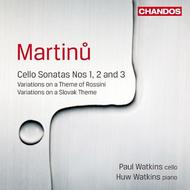
Martinu - 3 Cello Sonatas, Variations
£15.15 £12.88
save £2.27 (15%)
special offer ending 01/01/2026
In stock - available for despatch within 1 working day
Despatch Information
This despatch estimate is based on information from both our own stock and the UK supplier's stock.
If ordering multiple items, we will aim to send everything together so the longest despatch estimate will apply to the complete order.
If you would rather receive certain items more quickly, please place them on a separate order.
If any unexpected delays occur, we will keep you informed of progress via email and not allow other items on the order to be held up.
If you would prefer to receive everything together regardless of any delay, please let us know via email.
Pre-orders will be despatched as close as possible to the release date.
Label: Chandos
Cat No: CHAN10602
Format: CD
Number of Discs: 1
Genre: Chamber
Release Date: 28th June 2010
Contents
Works
Cello Sonata no.1, H277Cello Sonata no.2, H286
Cello Sonata no.3, H340
Variations on a Slovak folk song, for cello and piano, H378
Variations on a theme of Rossini, for cello and piano, H290
Artists
Paul Watkins (cello)Huw Watkins (piano)
Works
Cello Sonata no.1, H277Cello Sonata no.2, H286
Cello Sonata no.3, H340
Variations on a Slovak folk song, for cello and piano, H378
Variations on a theme of Rossini, for cello and piano, H290
Artists
Paul Watkins (cello)Huw Watkins (piano)
About
The three cello sonatas of the Czech composer Bohuslav Martinů span the period 1939–52 and are full of rewarding musical invention. The experience of his long exile was often expressed in his music, particularly here in the Third Sonata and in the Variations on a Slovak Theme.
In the First Sonata, competed in 1939, if the unease occasioned by World War II may be detected in the first two movements, the energetic finale, driven by Martinů’s motoric rhythms, prompted the composer to remark of its first performance: ‘It came as a last greeting, a beam of light from a better world (which is the opinion of others, not my own). For several minutes we realised what music could give us and we forgot about reality.’
In the Second Sonata, of 1941, the composer embraced classical forms, though the first movement is typically vigorous and energetic, in the composer’s most rhythmic manner. The second movement is full of passionate longing, with a gorgeous lyrical cello line, whilst the finale uses the composer’s characteristic motor rhythms, with powerful stamping gestures suggesting Bohemian peasant dances.
The Third Sonata, completed in October 1952, is the most immediately appealing of the three sonatas, full of attractive Czech melodies and offering essentially good-natured melodies and harmony – as well as humour, especially in the finale.
The Variations on a Theme of Rossini (1942), dedicated to Gregor Piatigorsky, shows the composer at his most wittily light-hearted, and offers brilliance and virtuosity in spades. The Variations on a Slovak Theme (1959) were written during the composer’s final illness – Martinů had been diagnosed with stomach cancer. They are certainly appealing and resourceful, but strong feelings for the distant homeland are distinctly audible.
Error on this page? Let us know here
Need more information on this product? Click here