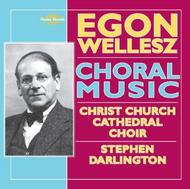
Egon Wellesz - Choral Music
£13.78
Usually available for despatch within 3-5 working days
Despatch Information
This despatch estimate is based on information from both our own stock and the UK supplier's stock.
If ordering multiple items, we will aim to send everything together so the longest despatch estimate will apply to the complete order.
If you would rather receive certain items more quickly, please place them on a separate order.
If any unexpected delays occur, we will keep you informed of progress via email and not allow other items on the order to be held up.
If you would prefer to receive everything together regardless of any delay, please let us know via email.
Pre-orders will be despatched as close as possible to the release date.
Label: Nimbus
Cat No: NI5852
Format: CD
Number of Discs: 1
Genre: Vocal/Choral
Release Date: 24th May 2010
Contents
Works
WelleszMass in F, Op.51
Wellesz
I Sing of a Maiden
Wellesz
Offertorium in Ascensione Domini
Wellesz
To Sleep Op.94
Wellesz
Missa Brevis Op.89
Artists
Clive Driskill-Smith (organ)Christ Church Cathedral Choir
Conductor
Stephen DarlingtonWorks
WelleszMass in F, Op.51
Wellesz
I Sing of a Maiden
Wellesz
Offertorium in Ascensione Domini
Wellesz
To Sleep Op.94
Wellesz
Missa Brevis Op.89
Artists
Clive Driskill-Smith (organ)Christ Church Cathedral Choir
Conductor
Stephen DarlingtonAbout
Wellesz’s operas of the 1920s contain a significant amount of virtuoso choral writing, and this quality carries over into his church music, although on the whole they are written in a simpler, more traditionally tonal idiom.
His first setting of the Mass was the Mass in F minor, Op.51 for chorus and organ, composed in 1934. Coming just a year into Hitler’s reign in Germany, it is tempting to read contemporary significance into this masterly but profoundly troubled work. The choice of key may suggest the example of Bruckner’s great F minor Mass – the two works might be said to have a certain majestic architectural quality, combined with intense emotional appeal, in common.
Wellesz’s last setting of the Mass was his unaccompanied Missa Brevis, Op.89, composed in 1963. Lasting only a third as long as the F minor Mass, this short work is on one level much simpler.
From 1965 comes one of Wellesz’s most impressive and affecting unaccompanied choral works, To Sleep, Op.94, a setting of John Keats sonnet. This work makes use of the more advanced harmonic and melodic tendencies of his late, freely 12-note idiom. But this is a deeply-felt setting that brings out the oppressive undertones of Keats’s words. Perhaps Wellesz, who had reached his eightieth year, felt this meditation on sleep and death especially keenly. In all events, he created a powerful vocal miniature that enshrines an eloquent response to the poem.
Error on this page? Let us know here
Need more information on this product? Click here