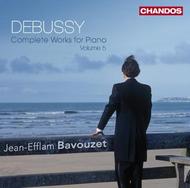
Debussy - Piano Works Vol.5
£15.15 £12.88
save £2.27 (15%)
special offer ending 01/01/2026
In stock - available for despatch within 1 working day
Despatch Information
This despatch estimate is based on information from both our own stock and the UK supplier's stock.
If ordering multiple items, we will aim to send everything together so the longest despatch estimate will apply to the complete order.
If you would rather receive certain items more quickly, please place them on a separate order.
If any unexpected delays occur, we will keep you informed of progress via email and not allow other items on the order to be held up.
If you would prefer to receive everything together regardless of any delay, please let us know via email.
Pre-orders will be despatched as close as possible to the release date.
Label: Chandos
Cat No: CHAN10545
Format: CD
Number of Discs: 1
Genre: Instrumental
Release Date: 26th October 2009
Contents
Artists
Jean-Efflam Bavouzet (piano)About
Sir Charles Stanford subjected all music to what he called a ‘piano test’: if it didn’t stand up to being played on the piano, then it wasn’t to be taken seriously. In the case of Debussy, all the French composer’s scores went through a notational stage which, if not specifically designed for piano, could be given a reasonably accurate performance on that instrument. Where ballets were concerned, obviously the choreographer had to rehearse the dancers to the accompaniment of a piano score that conformed to the rhythms and structure of the final orchestral product. The three piano versions recorded here were therefore intimately related to both the compositional and production processes.
Khamma stems from a commission in 1910 for an Egyptian ballet, originally entitled Isis. The project was troubled from the start when Debussy refused to reduce the orchestra from 90 to 40 players. He never heard the work, which was first given its concert performance in 1924. Bavouzet writes, ‘I discovered almost by chance in a Parisian music store, a version for piano of Khamma. This had previously escaped me so what was my surprise when I saw the richness and originality! The virtuosity required is much more subtle than the more obvious. It must give the illusion of more perfect sound levels corresponding to each specific instruments group.’
In the midst of the negotiations over Khamma, Debussy wrote his second ballet, Jeux. Jeux is a highly complex and incomprehensible piece for two hands. Bavouzet notes, ‘In several places what Debussy wrote in the reduction for solo piano is really unplayable. The text is so thin and poor that a small part of the richness of the orchestral version is realised. It was indeed this frustration that prompted me to write some years ago, a version for two pianos today published by Durand. But for this disc I had to make a version for two hands to do justice to the score. I can say that this is probably one of the most difficult works that I have played.’
Two months after the Jeux premiere, Debussy began work on his last ballet, La boîte à joujoux, based on an illustrated children’s story. Debussy embraced the plot, busy ‘extracting secrets from [his daughter] Chouchou’s old dolls and learning to play the side drum’. Within a month, the first tableau was done, and he claimed he had ‘tried to be straightforward and even “amusing”, without pretentiousness or pointless acrobatics'. The following month the piano score was complete.
Jean-Efflam concludes, ‘In my opinion the transcriptions can offer greater clarity and organisation of musical discourse. Young conductors have told me that they understood the score of Jeux better after hearing the version for two pianos… for those who do not know these three ballets in their orchestral version, this disc may give them the curiosity to explore the works further.’

Error on this page? Let us know here
Need more information on this product? Click here