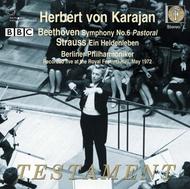
Karajan conducts Beethoven and Strauss
£11.35
Usually available for despatch within 2-3 working days
Despatch Information
This despatch estimate is based on information from both our own stock and the UK supplier's stock.
If ordering multiple items, we will aim to send everything together so the longest despatch estimate will apply to the complete order.
If you would rather receive certain items more quickly, please place them on a separate order.
If any unexpected delays occur, we will keep you informed of progress via email and not allow other items on the order to be held up.
If you would prefer to receive everything together regardless of any delay, please let us know via email.
Pre-orders will be despatched as close as possible to the release date.
Label: Testament
Cat No: SBT1452
Format: CD
Number of Discs: 1
Genre: Orchestral
Release Date: 13th July 2009
Contents
Artists
Berliner PhilharmonikerConductor
Herbert von KarajanWorks
Symphony no.6 in F major, op.68 'Pastoral'Ein Heldenleben (A Hero's Life), op.40
Artists
Berliner PhilharmonikerConductor
Herbert von KarajanAbout
Stereo, previously unreleased
This unusual pairing was not without point. Towards the end of Ein Heldenleben, as Strauss’s hero is lacerated with doubt as to the value and purpose of his existence, he contemplates becoming a shepherd. The idea does not persist. So complete a withdrawal from the world was too drastic a move for a young man possessed of so strong a sense of mission. (Strauss was only 34 when he wrote Ein Heldenleben.) The psychic upheaval has, however, caused him to understand the power of renunciation, a power that will bring true contentment when the time for retirement finally comes.
Beethoven’s Pastoral Symphony has a not dissimilar trajectory. Beginning with the sensation of ‘pleasant, cheerful feelings awakened on arrival in the countryside’, it ends with a sweet-sung finale during which Beethoven becomes the shepherds, sharing with them their mood of thanksgiving before a distant horn, emblem of autumn and the dying year, sounds its lament. To call either piece ‘programmatic’ is to misrepresent it. Beethoven’s Pastoral does not so much describe nature as explore the feelings it arouses in the human heart and imagination; Ein Heldenleben is as much a study of evolving states of mind as a paean to the heroic ideal.
It is also worth remarking that both works offer ingenious adaptations of classical form. Where Beethoven adapts the four-movement symphonic structure by linking scherzo and finale by means of a Storm that takes the idea of a brief preface to the finale into hitherto unimagined territory, so Strauss confounds his critics by creating a tone-poem that has its roots in an extended classical sonata-form structure. There are six sections: first subject (the hero), transitional subject (his adversaries the critics), second subject (his wife and companion in love), development (deeds of war), recapitulation (works of peace and troubled self-analysis), and coda (fulfilment in retirement).
From the booklet note , © Richard Osborne, 2009
Error on this page? Let us know here
Need more information on this product? Click here