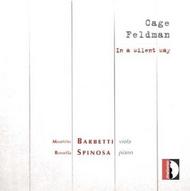
Cage / Feldman - In a Silent Way
£15.15
Usually available for despatch within 3-5 working days
Despatch Information
This despatch estimate is based on information from both our own stock and the UK supplier's stock.
If ordering multiple items, we will aim to send everything together so the longest despatch estimate will apply to the complete order.
If you would rather receive certain items more quickly, please place them on a separate order.
If any unexpected delays occur, we will keep you informed of progress via email and not allow other items on the order to be held up.
If you would prefer to receive everything together regardless of any delay, please let us know via email.
Pre-orders will be despatched as close as possible to the release date.
Label: Stradivarius
Cat No: STR33819
Format: CD
Number of Discs: 1
Release Date: 27th April 2009
Contents
Works
FeldmanFor Aaron Copland
Feldman
Piano Piece for piano (to Philip Guston)
Feldman
The viola in My Life III
Cage
Nocturne
Cage
Ophelia (for Jean Erdman)
Cage
Dream
Cage
Melodies Nos 5 and 6
Cage
Eight Whiskus
Cage
In a Landscape (for Louise Lippold)
Artists
Maurizio Barbetti (viola)Rossella Spinosa (piano)
Works
FeldmanFor Aaron Copland
Feldman
Piano Piece for piano (to Philip Guston)
Feldman
The viola in My Life III
Cage
Nocturne
Cage
Ophelia (for Jean Erdman)
Cage
Dream
Cage
Melodies Nos 5 and 6
Cage
Eight Whiskus
Cage
In a Landscape (for Louise Lippold)
Artists
Maurizio Barbetti (viola)Rossella Spinosa (piano)
About
In the USA a succession of quiet revolutions evolved: from a phase of heroic experimentation to the ‘success’ of the minimalist school at the end of the 1970s, but on the way findng some pieces that could rightly be termed ‘seminal’.
One of the keystones for understanding American New Music in the late post-war period is the close relationship between sound and vision. The first graphic scores were born and constant associations commenced with Robert Rauschenberg and the protagonists of Abstract Expressionism like De Kooning, Philip Guston and Mark Rothko, the latter favoured by Feldman.
In downtown Manhattan, some of the most radical and subversive minds of the artistic world's established order saw lifelong fellowships and friendships formed, like those between Cage and Rauschenberg, Feldman and Guston and Cage and Feldman, albeit with some troubled moments.
The chamber-jazz label ECM used to market itself with "The next best
sound to silence", an apophthegm more appropriately applied to the
Error on this page? Let us know here
Need more information on this product? Click here