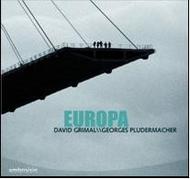
EUROPA - Music for Violin and Piano
£12.83
In stock - available for despatch within 1 working day
Despatch Information
This despatch estimate is based on information from both our own stock and the UK supplier's stock.
If ordering multiple items, we will aim to send everything together so the longest despatch estimate will apply to the complete order.
If you would rather receive certain items more quickly, please place them on a separate order.
If any unexpected delays occur, we will keep you informed of progress via email and not allow other items on the order to be held up.
If you would prefer to receive everything together regardless of any delay, please let us know via email.
Pre-orders will be despatched as close as possible to the release date.
Label: Naive
Cat No: AMB163
Format: CD
Number of Discs: 1
Genre: Chamber
Release Date: 25th May 2009
Contents
Works
Rhapsody for Viola and Piano no.1, Sz86Violin Sonata no.3 in A minor, op.25
Violin Sonata, JW VII/7
Mythes (3), op.30
Artists
David Grimal (violin)Georges Pludermacher (piano)
Works
Rhapsody for Viola and Piano no.1, Sz86Violin Sonata no.3 in A minor, op.25
Violin Sonata, JW VII/7
Mythes (3), op.30
Artists
David Grimal (violin)Georges Pludermacher (piano)
About
Fifteen years before Bartók and Kodály began ‘harvesting’ folk music, Janáček was collecting thousands of Moravian folksongs in Hukvaldy, his native village, and the surrounding area. Bartók’s approach to folk music was a methodical one, and he and Kodály collected folk melodies as a team. As for Enesco, the title of his sonata, “In the character of Romanian folk music”, speaks for itself, whilst Janáček created a singular musical universe which does not belong to any particular school. The same cannot be said of Bartók, Szymanowski and Enesco, who were open to a wide variety of influences. For Szymanowski, the works of Austrian and German romanticists such as Chopin, Hindemith and Stravinsky provided inspiration, while Beethoven and Bach influenced Bartók. Enesco’s lyricism, on the other hand, can be traced back to Brahms, Richard Strauss and the vivid colours of French music.
David Grimal was born in 1973 in Paris and started to play the violin at the age of five. He won First Prize in violin and chamber music at the Paris Conservatory in 1993. Afterwards he did his postgraduate studies with Regis Pasquier, and later studied with Shlomo Mintz, and Isaac Stern. More recently he won the European Community and the European Radio Union Prizes in 1996, and received the Crédit National Fellowship Award. He was also honoured as the Classical discovery of the MIDEM 1997. He has performed as a soloist, amongst others with the English Chamber Orchestra, the Moscow Virtuosi, the Stockholm Chamber Orchestra, the Warsaw Symphony, the Bavarian Chamber Orchestra, I Musici di Padova, and the Paris Conservatory Orchestra.
Error on this page? Let us know here
Need more information on this product? Click here