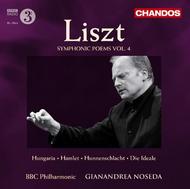
Liszt - Symphonic Poems Vol.4
£15.15 £12.88
save £2.27 (15%)
special offer ending 01/01/2026
In stock - available for despatch within 1 working day
Despatch Information
This despatch estimate is based on information from both our own stock and the UK supplier's stock.
If ordering multiple items, we will aim to send everything together so the longest despatch estimate will apply to the complete order.
If you would rather receive certain items more quickly, please place them on a separate order.
If any unexpected delays occur, we will keep you informed of progress via email and not allow other items on the order to be held up.
If you would prefer to receive everything together regardless of any delay, please let us know via email.
Pre-orders will be despatched as close as possible to the release date.
Label: Chandos
Cat No: CHAN10490
Format: CD
Number of Discs: 1
Genre: Orchestral
Release Date: 27th October 2008
Contents
Works
Die Ideale: symphonic poem, S106Hamlet: symphonic poem, S104
Hungaria: Symphonic Poem, S103
Hunnenschlacht: Symphonic Poem, S105
Artists
BBC Philharmonic OrchestraConductor
Gianandrea NosedaWorks
Die Ideale: symphonic poem, S106Hamlet: symphonic poem, S104
Hungaria: Symphonic Poem, S103
Hunnenschlacht: Symphonic Poem, S105
Artists
BBC Philharmonic OrchestraConductor
Gianandrea NosedaAbout
Between 1848 and 1858, Liszt wrote twelve Symphonic Poems. He coined the term Symphonische Dichtung around 1853 to describe these musical works whose ideas were inspired by other art forms such as poetry or painting, or by characters and scenes. The works were particularly revolutionary for they are one-movement compositions, rather than the traditional four-movement form and pushed the boundaries of orchestration, form, harmony and structure.
In this fourth instalment, the BBC Philharmonic presents four key works in Liszt’s symphonic catalogue. Widely acknowledged as one of Liszt’s greatest works, Hamlet is rarely performed, yet widely acknowledged as one of Liszt’s greatest works, and chronologically the last of the symphonic poems to be composed. It was intended as an overture to Shakespeare’s play.
Hungaria was composed following Liszt’s first return visit to Hungary in 1839, having moved from his homeland aged 11. He was welcomed with open arms as a great celebrity and artist by his compatriots. Undoubtedly inspired by this visit, the post Vörösmarty wrote his patriotic ode ‘To Ferenc Liszt’ to which Liszt eventually responded with his episodic work, Hungaria.
Die Ideale is a highly episodic work based on quotes from a poem by Friedrich Schiller and was first played in 1857 in Weimar, conducted by the composer. The final work, Battle of the Huns, takes its inspiration from Kaulbach’s painting of Attila the Hun.
Error on this page? Let us know here
Need more information on this product? Click here