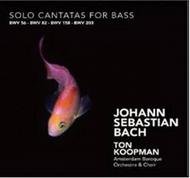
J S Bach - Solo Cantatas for Bass
£10.40
In stock - available for despatch within 1 working day
Despatch Information
This despatch estimate is based on information from both our own stock and the UK supplier's stock.
If ordering multiple items, we will aim to send everything together so the longest despatch estimate will apply to the complete order.
If you would rather receive certain items more quickly, please place them on a separate order.
If any unexpected delays occur, we will keep you informed of progress via email and not allow other items on the order to be held up.
If you would prefer to receive everything together regardless of any delay, please let us know via email.
Pre-orders will be despatched as close as possible to the release date.
Label: Challenge Classics
Cat No: CC72283
Format: CD
Number of Discs: 1
Genre: Vocal/Choral
Release Date: 28th April 2008
Contents
Works
Cantata BWV56 'Ich will den Kreuzstab gerne tragen'Cantata BWV82 'Ich habe genug'
Cantata BWV158 'Der Friede sei mit dir'
Cantata BWV203 'Amore traditore'
Artists
Klaus Mertens (bass)Amsterdam Baroque Orchestra & Choir
Conductor
Ton KoopmanWorks
Cantata BWV56 'Ich will den Kreuzstab gerne tragen'Cantata BWV82 'Ich habe genug'
Cantata BWV158 'Der Friede sei mit dir'
Cantata BWV203 'Amore traditore'
Artists
Klaus Mertens (bass)Amsterdam Baroque Orchestra & Choir
Conductor
Ton KoopmanAbout
The solo cantata “Ich will den Kreuzstab gerne tragen” BWV 56 was first performed on 27 October 1726, the 19th Sunday after Trinity. The author of the text is unknown, but he was apparently inspired by Erdmann Neumeister‘s “Ich will den Kreuzweg gerne gehen” from the latter’s cantata text collection of 1711.
“Ich habe genung” BWV 82 was composed for the Feast of the Purification of the Virgin Mary on 2 February 1727. The author of the text is also onknown.
The cantata “Der Friede sei mit dir” BWV 158 survives with designations for two liturgical occasions (Purification/Third Day of Easter) in a manuscript copied by a reliable scribe shortly after Bach‘s death. The origins of the work are therefore uncertain, but most likely it represents an expansion of a solo cantata originally written (like BWV 82) for the Marian Feast of Purification on 2 February.
“Amore traditore” BWV 203, in the typical format (aria-recitative-aria) of the Italian secular solo cantata, is based on an anonymous text that was also set by the Neapolitan composer Nicola Fago.
In 2006, Ton Koopman was awarded the Bach Medal by the city of Leipzig in recognition of his major contribution to Bach performance and scholarship.
Error on this page? Let us know here
Need more information on this product? Click here