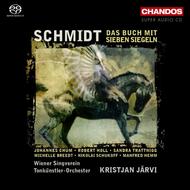
Schmidt - Das Buch mit sieben Siegeln
£30.35 £18.21
save £12.14 (40%)
special offer ending 01/01/2026
In stock - available for despatch within 1 working day
Despatch Information
This despatch estimate is based on information from both our own stock and the UK supplier's stock.
If ordering multiple items, we will aim to send everything together so the longest despatch estimate will apply to the complete order.
If you would rather receive certain items more quickly, please place them on a separate order.
If any unexpected delays occur, we will keep you informed of progress via email and not allow other items on the order to be held up.
If you would prefer to receive everything together regardless of any delay, please let us know via email.
Pre-orders will be despatched as close as possible to the release date.
Label: Chandos
Cat No: CHSA50612
Format: Hybrid SACD
Number of Discs: 2
Genre: Vocal/Choral
Release Date: 3rd March 2008
Contents
Artists
Johannes Chum (tenor)Robert Holl (bass baritone)
Sandra Trattnigg (soprano)
Michelle Breedt (mezzo-soprano)
Nikolai Schukoff (tenor)
Manfred Hemm (bass)
Robert Kovacs (organ)
Wiener Singverein
Tonkunstler Orchester Niederosterreich
Conductor
Kristjan JarviWorks
Das Buch mit sieben Siegeln (The Book of Seven Seals)Artists
Johannes Chum (tenor)Robert Holl (bass baritone)
Sandra Trattnigg (soprano)
Michelle Breedt (mezzo-soprano)
Nikolai Schukoff (tenor)
Manfred Hemm (bass)
Robert Kovacs (organ)
Wiener Singverein
Tonkunstler Orchester Niederosterreich
Conductor
Kristjan JarviAbout
Schmidt composed his oratorio Das Buch mit sieben Siegeln in 1935-7, when Schmidt’s health was quickly failing and with a particularly keen sense of his own mortality. The composition wittingly or unwittingly seems to tap into the feelings of the time, and his apocalyptic visions soon became realities.
It was written at a time when the opposite poles of contemporary music were represented by the internationally renowned music of Schoenberg and Stravinsky. Their pioneering styles seemed at the time to be mutually exclusive and left little room for those who did not obviously adhere to one camp or the other.
Sadly, Schmidt’s music seemed a highly conservative continuation of an outmoded romanticism, greatly influenced by his teachers Bruckner and Fuchs and his Hungarian origins. Today, with the benefit of hindsight, it is precisely Schmidt’s refusal to pander to modernistic trends that endows his distinctive contribution to twentieth-century music with a refreshing integrity and individuality and Das Buch is now, justifiably, seen as one of the greatest epic works of the Twentieth Century.
The Tonkünstler Orchestra is one of the most important institutions of Austrian musical culture, exploring not only repertoire based on almost a hundred years of history, but also exploring new or unfamiliar works from the past three centuries under its principal conductor, Kristjan Järvi.

Error on this page? Let us know here
Need more information on this product? Click here