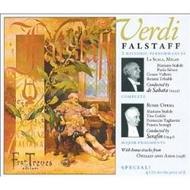
Giuseppe Verdi - Falstaff : 2 Historic Performances
£22.75 £19.34
save £3.41 (15%)
special offer ending 01/01/2026
Usually available for despatch within 3-5 working days
Despatch Information
This despatch estimate is based on information from both our own stock and the UK supplier's stock.
If ordering multiple items, we will aim to send everything together so the longest despatch estimate will apply to the complete order.
If you would rather receive certain items more quickly, please place them on a separate order.
If any unexpected delays occur, we will keep you informed of progress via email and not allow other items on the order to be held up.
If you would prefer to receive everything together regardless of any delay, please let us know via email.
Pre-orders will be despatched as close as possible to the release date.
Label: Music and Arts
Cat No: MACD1104
Format: CD
Number of Discs: 4
Genre: Opera
Release Date: 31st July 2002
Contents
Artists
Mariano StabilePaolo Silveri
Cesare Valletti
Mariano Caruso
Giuseppe Nessi
Italo Taio
Renata Tebaldi
Cloë Elmo
Anna Maria Canali
Tito Gobbi
Ferruccio Tagliavini
Adelia Zagenara
Cesare Masini-sperti
Franca Somigli
Augusta Oltrabella
Cloë Elmo
Vittorico Palambini
La Scala
Rome Opera
Conductors
Victor De SabataTullio Serafin
Works
FalstaffArtists
Mariano StabilePaolo Silveri
Cesare Valletti
Mariano Caruso
Giuseppe Nessi
Italo Taio
Renata Tebaldi
Cloë Elmo
Anna Maria Canali
Tito Gobbi
Ferruccio Tagliavini
Adelia Zagenara
Cesare Masini-sperti
Franca Somigli
Augusta Oltrabella
Cloë Elmo
Vittorico Palambini
La Scala
Rome Opera
Conductors
Victor De SabataTullio Serafin
About
Critic Alan Blyth writes in his liner notes:
"The La Scala performance of 1952 is enlivened by De Sabata's superb conducting, at once precise, energetic, imbued with the rightful comedy and altogether exhilarating. The veteran baritone seems inspired by his conductor to present an even more imaginative and detailed portrayal than ever before, one quite unstaled by the thousand or so performances he had already given. This is a matter of subtler emphases and vocal chuckles that are so vivid as almost to bring the character before one at home. A critic who saw and heard him at the time wrote that he had to resort to some technical tricks to cover up a voice that was no longer in its prime, but added: "To offset that, his colouring of words was unique as were his gestures, how he moved, his command of the stage".
The 1941 Rome performance, or as much of it as survives, stems from the collection of the German Radio Archive in Frankfurt, and appears for the first time. It seems to be a studio performance as there is no evidence of any audience participation or stage movement. The sound is remarkable for its day. The recording houses an interpretation from Tullio Serafin markedly different from De Sabata's. Serafin's view of the work seems to be more autumnal, more ruminative than that of his Italian near-contemporary. No less well prepared or well played, it allows us to hear even more of the magic of the orchestration.
The most important aspect of the wartime performance is the presence of Tito Gobbi as Ford. Later he was, of course, a famous Falstaff, but no other souvenir exists of him as Ford. At the time of this performance he was a valued member of the Rome ensemble, having made his debut at the Rome Opera in the 1939-40 season. His voice already has its peculiarly distinctive timbre and he is already a master at projecting character through nourishing the text. His and Stabile's account of their Act 2 encounter, full of verbal wit, is a classic of ensemble playing, the one singer encouraging the other to greater heights of intimate colloquy. So, by and large, this is an important addition to the discography of the opera, one to be savoured by the many lovers of the enchanting piece.
Stabile is the only singer common to both versions. More than ten years earlier he is in more rounded voice and seems able to summon up all his histrionic powers without the help of stage action. Thanks to a better quality of sound, one can hear still more of the skills he deploys in creating a rounded portrait of Falstaff.
Stabile sang the role no fewer than 1200 times. He gave it during his first season at Covent Garden in 1926, the year he made recordings of excerpts for Columbia. His first recording of anything from the role was a few months after his 1921 debut in the part was the Honour monologue and scene the with Alice in Act 2. During his return to London in the late 1940s, he recorded Falstaff's two monologues with enormous relish for British Columbia. He also made some extracts from the work for Telefunken in 1942, but no commercial recording was ever made of his complete reading, which is what makes the live performances now preserved on CD so important.
His performance at La Scala in 1952 marked the thirtieth anniversary of his first assumption of the role in the house on 26 December 1921, the opening of La Scala after the first world war. when he benefited ftom the scrupulous coaching of Toscanini and of Giuseppe De Luca, his great predecessor in the part. Interestingly enough, one of Stabile's most accomplished successors in the part, Giuseppe Valdengo, also learnt the role in meticulous detail from Toscanini before the maestro's famous concert performance and recording of the work in 1950.
Error on this page? Let us know here
Need more information on this product? Click here