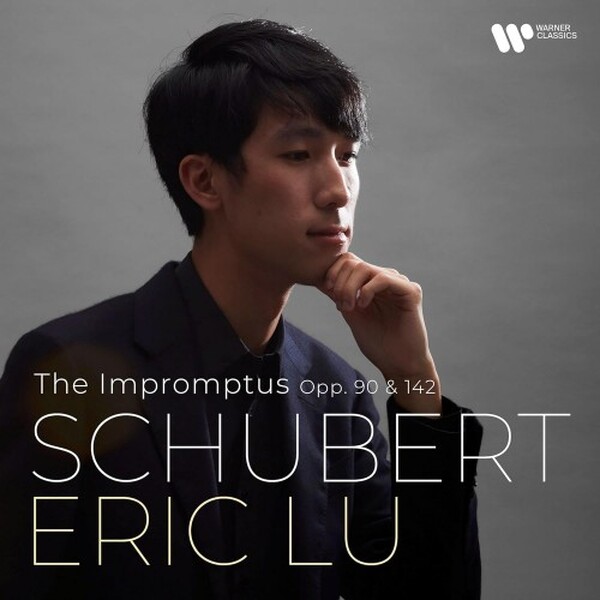
Schubert - The Impromptus, opp. 90 & 142
£15.15 £14.20
save £0.95 (6%)
special offer ending 28/02/2026
Despatch Information
This despatch estimate is based on information from both our own stock and the UK supplier's stock.
If ordering multiple items, we will aim to send everything together so the longest despatch estimate will apply to the complete order.
If you would rather receive certain items more quickly, please place them on a separate order.
If any unexpected delays occur, we will keep you informed of progress via email and not allow other items on the order to be held up.
If you would prefer to receive everything together regardless of any delay, please let us know via email.
Pre-orders will be despatched as close as possible to the release date.
Label: Warner
Cat No: 2173286931
Format: CD
Number of Discs: 1
Genre: Instrumental
Expected Release Date: 9th January 2026
Contents
Artists
Eric Lu (piano)About
“The First Impromptu is perhaps the greatest of all the Impromptus. Beginning with that hollow, fortissimo double-octave G, there follows the loneliest of themes, extremely simple and emotionally profound. One is aware of being at the start of a grand journey in which each section slowly unfolds into the next, bound together by persistent yet restrained repeated notes, before the music is unleashed in brief, gushing climaxes. Meanwhile, we are simultaneously winding through some of the most beautiful passages ever written for the piano.”
Produced during the astonishingly fruitful year before the composer’s death aged 31, the Impromptus are short, lyrical miniatures of contrasting mood and character which, when considered together, create a musical narrative whose imaginative reach transports the listener far beyond the 19th-century drawing room. They have been core components of Lu’s repertoire for several years, but the pianist decided to wait before recording them. “I have a real sense of a journey with these works, in particular with Op.90, having lived with them intensely in preparation, on stage and, finally, in the recording studio,” he says. “For me, the Impromptus are some of the greatest jewels in the piano literature. They are magnificent, deep pieces of music, and the very essence of Schubert.” The sense of an inner journey is ever present in the Impromptus, where emotions continually shift and struggle. While the Op.90 set has, on the surface, a generally equable mood, this feeling is fragile.
“The second Impromptu starts off in a serene atmosphere, but in late-Schubert fashion this bliss cannot last for long,” says Lu. Written in ternary form, the breezy running triplets that characterise the first section soon give way to a powerful, roughshod four-bar waltz in B minor. “The middle section is full of drama and very poignant, in a more pronounced way. The A-section then returns, before the extended coda – based around the second subject and marked fortissimo – ends with a written accelerando, falling all the way to an outburst of an ending.”
A sense of profound longing suffuses Impromptu no.3, in G flat major, one of the most beautiful pieces to come from Schubert’s pen. Above a gently rippling arpeggiated accompaniment floats a melody that evolves with such Romantic inevitability that the piece might almost have written itself. “This is a song for solo piano,” says Lu. “One cannot begin to explain how Schubert took these individual elements of melody, harmonic progression and accompaniment and created something so beautiful.”
The popular fourth Impromptu, an Allegretto in A flat major, in fact opens in A flat minor. Cascading semiquaver (sixteenth-note) figurations characterise the piece, followed by gentle answering chords, and the music moves through a variety of keys almost in the manner of an étude. The Trio, with its repeated chords and drawn-out melody, is full of foreboding. “As always in these Impromptus, and practically all late Schubert, he turns to darkness,” says Lu. But equally with Schubert, the darkness yearns for the light, which finally arrives with the recapitulation. The piece ends with a magnificent A flat major descent and an emphatic V–I close.
Originally intended as a continuation of the first set of impromptus, the Impromptus, D935, only appeared in print in 1839, more than a decade after Schubert’s death, when the Austrian publisher Anton Diabelli issued them as a self-contained set. “As with the Op.90 Impromptus, the first one of D935, in F minor, is the longest and perhaps the greatest of the set,” says Lu. “The work starts very dramatically and unfolds in a way that shows that we are embarking on a journey.”
The piece begins with an angular dotted-rhythm theme punctuated by forceful accents, but this is a musical foil akin to the fortissimo double-octave G that opens the First Impromptu from D899: the thematic material that immediately follows, with its gently undulating pianissimo semiquavers, culminates in a beautifully affecting chordal melody.
“The theme in A flat major builds from the motifs heard on the first page, before going into the most incredible middle section in A flat minor,” Lu continues. “Here, the left hand, carrying the melody, crosses back and forth over the right hand, which plays a rippling arpeggio accompaniment. It is the ultimate passage of poetry and narration in extremely long phrases.”
The second occurrence of this enchanting middle section, now in F minor, leads to a restatement of the assertive first subject, but the music quickly subsides as the work reaches its close. “The coda finally returns to the first theme, and the piece concludes with typically Schubertian ‘heavenly lengths’.”
Impromptu no.2 is a minuet and trio in A flat major in Allegretto tempo. An entreating minuet theme with chordal accompaniment is followed by a contrasting trio in D flat major characterised by a continuously flowing triplet motion. The mood deepens as the music moves to D flat minor, before the piece climaxes with a resounding A major arpeggio cascade. “The second Impromptu in A flat major is a work of incredible tenderness – pure and heavenly music,” says Lu.
The Third Impromptu, in B flat major, is a set of variations based on the genial melody from the incidental music Schubert composed for Helmina von Chézy’s play Rosamunde. (The theme also resembles that of the Andante second movement of Schubert’s String Quartet no.13 in A minor, “Rosamunde”.) In contrast to the showy variations that were fashionable at the time, Schubert takes a characteristically exploratory approach to texture and harmony. The mood throughout is generally serene; only the third variation, in the minor key, brings an element of disquiet, while the fifth, replete with elegant scale passages, ventures to the key of G flat major. The Più lento coda brings the Impromptu to a quiet and understated close.
The Hungarian-infused final Impromptu, an Allegro scherzando in F minor and 3/8-time, is a box of pianistic delights, from the hemiola “off-beat” rhythmic effect that propels the music ever onward, to the flashes of improvisatory brilliance including audacious double-octave scale passages and sweeping glissandi. The music is broadly in A–B–A rondo form, and while “A” stays close to the key signature, the middle “B” section – in the relative A flat major and beginning with a pianissimo right-hand scale passage – is harmonically expansive. The sense of the music travelling to distant places only serves to demonstrate Schubert’s mastery at recapitulation, which is here followed by an extraordinary extended coda featuring a staccato triplet figure repeated over a shifting chordal bass. There is a pause before the music, now fortissimo, accelerates towards its closing gesture: a dramatic sweep of the keyboard from the top note to the bottom.
Error on this page? Let us know here
Need more information on this product? Click here