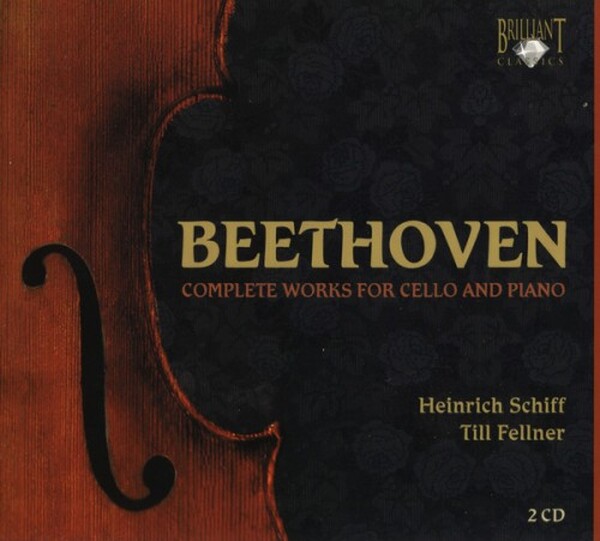
Beethoven - Complete Works For Cello And Piano
£5.11
In stock - available for despatch within 1 working day
Despatch Information
This despatch estimate is based on information from both our own stock and the UK supplier's stock.
If ordering multiple items, we will aim to send everything together so the longest despatch estimate will apply to the complete order.
If you would rather receive certain items more quickly, please place them on a separate order.
If any unexpected delays occur, we will keep you informed of progress via email and not allow other items on the order to be held up.
If you would prefer to receive everything together regardless of any delay, please let us know via email.
Pre-orders will be despatched as close as possible to the release date.
Label: Brilliant Classics
Cat No: 93895
Format: CD
Number of Discs: 2
Genre: Instrumental
Contents
Works
BeethovenCello Sonata in F Op.5 No.1
Beethoven
Cello Sonata in G minor Op.5 No.2
Beethoven
Cello Sonata in A Op.69
Beethoven
Cello Sonata in C Op.102 No.1
Beethoven
Cello Sonata in D Op.102 No.2
Beethoven
12 Variations on ‘See, the conqu’ring hero comes’ WoO45
Beethoven
12 Variations on ‘Ein Madchen oder Weibchen’ Op.66
Beethoven
7 Variations on ‘Bei Männern, welche Liebe fuhlen’ WoO46
Artists
Heinrich SchiffTill Fellner
Works
BeethovenCello Sonata in F Op.5 No.1
Beethoven
Cello Sonata in G minor Op.5 No.2
Beethoven
Cello Sonata in A Op.69
Beethoven
Cello Sonata in C Op.102 No.1
Beethoven
Cello Sonata in D Op.102 No.2
Beethoven
12 Variations on ‘See, the conqu’ring hero comes’ WoO45
Beethoven
12 Variations on ‘Ein Madchen oder Weibchen’ Op.66
Beethoven
7 Variations on ‘Bei Männern, welche Liebe fuhlen’ WoO46
Artists
Heinrich SchiffTill Fellner
About
From the beginning, Beethoven set out to test the cello to its limits. The Op.69 calls for the widest possible range of notes available on a six-octave instrument. Even the Op.5 (dedicated to Emperor Friedrich Wilhelm II, a skilled amateur cellist), written for the virtuoso cellist Jean-Pierre Duport, throw the spotlight on the cello – unusual for duo sonatas of the period. Many were published as sonatas for the piano with either violin or cello accompaniment. The cello of this period was capable of significantly more colour and expression than the fortepiano, and this may have prompted Beethoven to let the cello ‘sing out’ over the more limited piano.
By the time of the Op.102 sonatas, Beethoven’s style and musical palate had changed hugely. We are in the same territory as the String Quartet Op.95, the first of the late piano sonatas and the sketches of the Ninth Symphony. The textures are lean, and Op.102 No.2 contains a fugue – contrapuntal writing was exerting a fascination on Beethoven in his late period as can be heard from the ‘Consecration of the House’ Overture of the same period. The fugues of the ‘Hammerklavier’ Sonata, Diabelli Variations, the Große Fuge and Missa solemnis are just a few years away.
"What remains in the mind most strongly are the beautifully realised introspective moments … I’d recommend Schiff and Fellner for the way they make the music sing." - Gramophone, June 2000
Recording made by Philips in 1998.
Error on this page? Let us know here
Need more information on this product? Click here