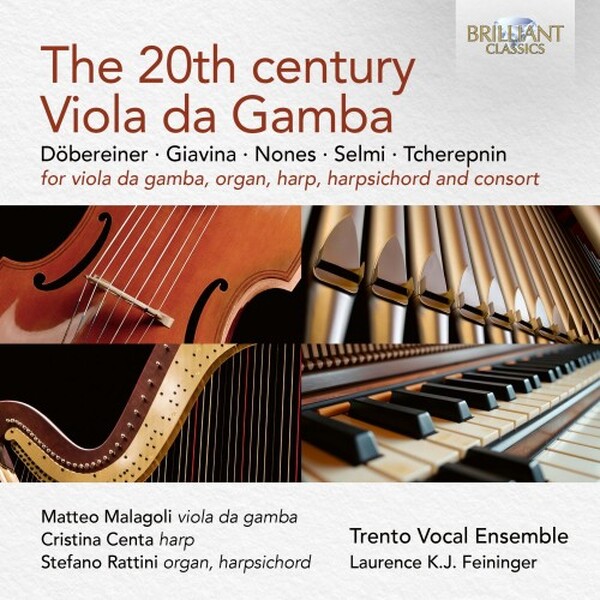
The 20th-century Viola da Gamba
£9.45
In stock - available for despatch within 1 working day
Despatch Information
This despatch estimate is based on information from both our own stock and the UK supplier's stock.
If ordering multiple items, we will aim to send everything together so the longest despatch estimate will apply to the complete order.
If you would rather receive certain items more quickly, please place them on a separate order.
If any unexpected delays occur, we will keep you informed of progress via email and not allow other items on the order to be held up.
If you would prefer to receive everything together regardless of any delay, please let us know via email.
Pre-orders will be despatched as close as possible to the release date.
Label: Brilliant Classics
Cat No: 97568
Format: CD
Number of Discs: 1
Release Date: 14th November 2025
Contents
Works
Missa Orbis factor (plainchannt)Capriccio in Style of Marin Marais
Marcetta cinese
Menuett in D major
Sarabanda in A major
Prelude, Fantasy and Postlude in Old Style
Algoritmi
Fantasy on Kyrie from Missa Orbis factor
Partite diverse on the Chorale 'Wass Gott tut, das ist wohlgetan'
Allegro vivace all'ungherese
Il trovadorico
Tirolese - Allegro brillante
Sonata da chiesa, op.101
Artists
Matteo Malagoli (viola da gamba)Cristina Centa (harp)
Stefano Rattini (organ, harpsichord)
Trento Vocal Ensemble
Conductor
Laurence KJ FeiningerWorks
Missa Orbis factor (plainchannt)Capriccio in Style of Marin Marais
Marcetta cinese
Menuett in D major
Sarabanda in A major
Prelude, Fantasy and Postlude in Old Style
Algoritmi
Fantasy on Kyrie from Missa Orbis factor
Partite diverse on the Chorale 'Wass Gott tut, das ist wohlgetan'
Allegro vivace all'ungherese
Il trovadorico
Tirolese - Allegro brillante
Sonata da chiesa, op.101
Artists
Matteo Malagoli (viola da gamba)Cristina Centa (harp)
Stefano Rattini (organ, harpsichord)
Trento Vocal Ensemble
Conductor
Laurence KJ FeiningerAbout
Limited interest in the instrument persisted through the 19th century, until a rebirth occurred thanks to German cellists Christian Döbereiner (1874–1961) and Paul Grümmer (1879–1965), and later the Austrian Karl Maria Schwamberger (1905–1967) and Swiss cellist August Wenzinger (1905–1996), a pupil of Grümmer’s and a founder, in 1925, of one of Germany’s first early music ensembles. Wenzinger was appointed cello and viola da gamba teacher at Basle’s new Schola Cantorum Basiliensis, where Giacomo Nones (1929–2017) and Jordi Savall (b. 1941) would become his pupils.
Döbereiner was one of the most important pioneers at the dawn of modern research into historical performance practice, considered to have revived both the viola da gamba and the baryton from obscurity. From his Sarabande, in Handelian style, only the solo part has survived, and the basso continuo has been reconstructed by Matteo Malagoli.
Alexander Tcherepnin (1899–1977) was an important Russian pianist and composer. He invented his own harmonic language, combining major and minor hexachords in a pentatonic scale that blended old Russian patterns and Georgian (Caucasian) harmonies. During a stay in France he became friends with Paul Grümmer and in 1969 published a lovely Sonata da chiesa for viola da gamba and organ dedicated to Grümmer and his daughter Sylvia.
Giuseppe Selmi (1912–1987) was a gifted concert cellist, performing both with orchestra and piano. As a composer, he wrote several works for solo cello, with piano and with harp (he played in a duo with his wife Maria Dongellini). Following the gift of a viola da gamba (built by Paolo Leonori in 1952) from his wife in the 1970s, he became a passionate advocate for the instrument, writing works for it with harp or solo.
Giacomo Nones (1929–2017) dedicated himself from a young age to classical music and the popular music from his native Trentino, studying violin, organ and viola da gamba, as well as musicology and organology. He has edited transcriptions and publications of Renaissance and Baroque music and has collaborated with various early music ensembles. Passionate about contemporary music, in particular ‘computer music’, he wrote his 10 small Algorithms for two viols with the use of a computer according to theories by the Russian mathematician Rudolf Zaripov. His only other viola da gamba works are the very different Partitas on the Lutheran chorale Was Gott tut, das ist wohlgetan for gamba and organ, and the Fantasia for solo viol on the Kyrie of the Gregorian ‘Orbis factor’ Mass.
Riccardo Giavina (1937–2019) was a Piedmontese pianist and composer, later a teacher and headmaster at the ‘Bonporti’ Conservatory of Trento and Riva del Garda. A friend of Giacomo Nones, in April 1977 he dedicated his three short pieces for three viols (soprano, tenor and bass) to the other composer. Written in late Renaissance style, they are aimed at extending the original literature for viola da gamba into the 20th century.
Error on this page? Let us know here
Need more information on this product? Click here