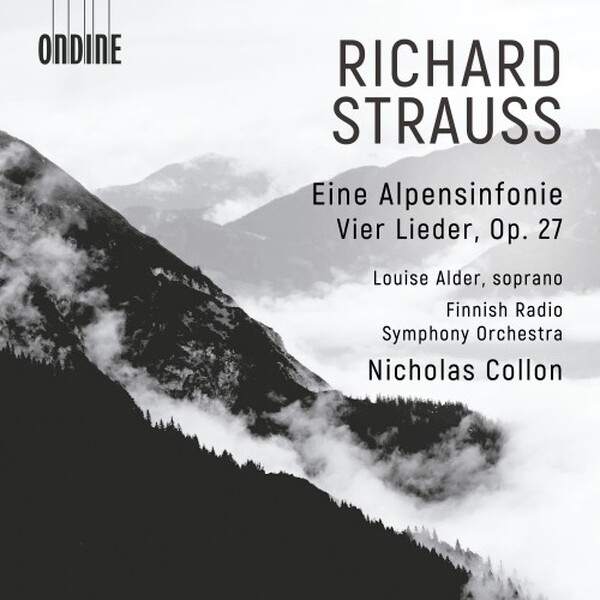
R Strauss - Eine Alpensinfonie, 4 Lieder op.27
£14.73
In stock - available for despatch within 1 working day
Despatch Information
This despatch estimate is based on information from both our own stock and the UK supplier's stock.
If ordering multiple items, we will aim to send everything together so the longest despatch estimate will apply to the complete order.
If you would rather receive certain items more quickly, please place them on a separate order.
If any unexpected delays occur, we will keep you informed of progress via email and not allow other items on the order to be held up.
If you would prefer to receive everything together regardless of any delay, please let us know via email.
Pre-orders will be despatched as close as possible to the release date.
Label: Ondine
Cat No: ODE14792
Format: CD
Number of Discs: 1
Release Date: 5th December 2025
Contents
Artists
Louise Alder (soprano)Finnish Radio Symphony Orchestra
Conductor
Nicholas CollonWorks
Eine Alpensinfonie (An Alpine Symphony), op.64Lieder (4), op.27
Artists
Louise Alder (soprano)Finnish Radio Symphony Orchestra
Conductor
Nicholas CollonAbout
Recalling a mountain trek from his childhood, Strauss completed An Alpine Symphony, op.64, the longest and grandest of his orchestral works, in February 1915. Strauss wrote his orchestral work following a fruitful period that had produced several operas, including Salome, Elektra and Der Rosenkavalier. Although Strauss gave the title “symphony” to his Alpine-inspired work, its pictorial and narrative characteristics, episodic form and thematic metamorphosis all suggest an affinity with the tone-poem genre. The work is sub-divided into twenty-two sections, some very brief and all clearly marked in the score. Its orchestration requires at least 125 players, the largest ensemble in Strauss’s entire output. Unusual instruments include heckelphone, Wagner tubas, organ, cow-bells, wind machine, thunder machine and a battalion of off-stage horns, trumpets and trombones. As Strauss was sketching the work in May 1911, he heard of Mahler’s death, a major loss to the musical world but also one which affected him personally. They had known each other for twenty-four years. Although the two composers’ aesthetics differed in significant ways Strauss did conduct several of Mahler’s symphonies and was influenced by him.
Strauss composed more than 200 songs, many with his wife’s soprano voice in mind. His Four Songs, op.27, are particularly intimate: Strauss presented them to his wife Pauline de Ahna as a wedding gift upon their marriage in September 1894. From these songs, Strauss composed Cäcilie in the evening of 9 September, the day before his marriage to Pauline. These four songs on love are lavishly orchestrated and Strauss returned to orchestrate these songs still half a century later, in the 1940s.
One of the most in demand artists today, British soprano Louise Alder has firmly established herself as “an instinctive singing-actress” (The Arts Desk) and “a terrific talent, combining a big, lustrous voice with flawless intonation and keen intelligence” (The Times). A hugely versatile artist she is equally at home in the world’s most important opera, concert and recital venues such as Royal Opera House, Covent Garden, Wiener Staatsoper, Glyndebourne Festival, Bayerische Staatsoper, Carnegie Hall and the Wigmore Hall, where she held a widely acclaimed artistic residency in 2024. Alder is set to make a thrilling debut at the Metropolitan Opera in the highly anticipated 2025–26 season. A hugely acclaimed recitalist, her appearances include the BBC Proms, the Musikverein in Graz, Madrid’s Fundación Juan March and the Fundación Privada Victoria de los Ángeles in Barcelona, Snape Maltings, and the Oxford International Song Festival. A former member of the ensemble of Oper Frankfurt, Alder studied at the Royal College of Music’s International Opera School where she was the inaugural Kiri Te Kanawa Scholar. She is the winner of the Young Singer Award at the 2017 International Opera Awards; the Dame Joan Sutherland Audience Prize at the 2017 Cardiff Singer of the World Competition; the 2015 inaugural Young British Soloists’ Competition; and is the recipient of Glyndebourne's 2014 John Christie Award.
The Finnish Radio Symphony Orchestra (FRSO) is the orchestra of the Finnish Broadcasting Company (Yle), and its mission is to produce and promote Finnish musical culture. The Radio Orchestra of ten players founded in 1927 grew to symphony orchestra proportions in the 1960s. Its Chief Conductors have been Toivo Haapanen, Nils-Eric Fougstedt, Paavo Berglund, Okko Kamu, Leif Segerstam, Jukka-Pekka Saraste, Sakari Oramo, Hannu Lintu, and as of autumn 2021 Nicholas Collon. In addition to the great Classical-Romantic masterpieces, the latest contemporary music is a major item in the repertoire of the FRSO, which each year premieres a number of Yle commissions. The FRSO has twice won a Gramophone Award: for its album of Lindberg’s Clarinet Concerto in 2006 and of Bartók Violin Concertos in 2018. Other distinctions have included BBC Music Magazine, Académie Charles Cros, MIDEM Classical awards and Grammy nominations in 2020 and 2021. Its album of tone poems and songs by Sibelius won an International Classical Music Award (ICMA) in 2018. In 2023, the orchestra was nominated for Gramophone’s Orchestra of the Year award and won a Gramophone Award for their Lotta Wennäkoski album.
British conductor Nicholas Collon is recognised for his elegant conducting style, searching musical intellect and inspirational music-making. He began as Chief Conductor of the Finnish Radio Symphony in August 2021 – the first non-Finnish conductor ever to hold this post. From 2016–2021 he was Chief Conductor of the Residentie Orkest in Den Haag (latterly also Artistic Advisor) and was Principal Guest of Gürzenich-Orchester from 2017–2022. He also leads the Aurora Orchestra in their residencies at Kings Place and at the Southbank, where they have reinvented the concert format with their “Orchestral Theatre” Series. Together they appear regularly at the Amsterdam Concertgebouw, Cologne Philharmonie, Elbphilharmonie Hamburg, and festivals such as Bremen, Rheingau, Schleswig Holstein, Gstaad, and the BBC Proms where they perform every year in their hugely popular memorised performances.
Sound/Video
Paused
-
1Vier Lieder, op.27 (1894): 1. Ruhe, meine Seele!
-
2Vier Lieder, op.27 (1894): 2. Cacilie
-
3Vier Lieder, op.27 (1894): 3. Heimliche Aufforderung (orch. Robert Heger)
-
4Vier Lieder, op.27 (1894): 4. Morgen!
-
5Eine Alpensinfonie, op.64 (1915): 1. Nacht
-
6Eine Alpensinfonie, op.64 (1915): 2. Sonnenaufgang
-
7Eine Alpensinfonie, op.64 (1915): 3. Der Anstieg
-
8Eine Alpensinfonie, op.64 (1915): 4. Eintritt in den Wald
-
9Eine Alpensinfonie, op.64 (1915): 5. Wanderung neben dem Bache
-
10Eine Alpensinfonie, op.64 (1915): 6. Am Wasserfall
-
11Eine Alpensinfonie, op.64 (1915): 7. Erscheinung
-
12Eine Alpensinfonie, op.64 (1915): 8. Auf blumigen Wiesen
-
13Eine Alpensinfonie, op.64 (1915): 9. Auf der Alm
-
14Eine Alpensinfonie, op.64 (1915): 10. Durch Dickicht und Gestrüpp auf Irrwegen
-
15Eine Alpensinfonie, op.64 (1915): 11. Auf dem Gletscher
-
16Eine Alpensinfonie, op.64 (1915): 12. Gefahrvolle Augenblicke
-
17Eine Alpensinfonie, op.64 (1915): 13. Auf dem Gipfel
-
18Eine Alpensinfonie, op.64 (1915): 14. Vision
-
19Eine Alpensinfonie, op.64 (1915): 15. Nebel steigen auf
-
20Eine Alpensinfonie, op.64 (1915): 16. Die Sonne verdüstert sich allmählich
-
21Eine Alpensinfonie, op.64 (1915): 17. Elegie
-
22Eine Alpensinfonie, op.64 (1915): 18. Stille vor dem Sturm
-
23Eine Alpensinfonie, op.64 (1915): 19. Gewitter und Sturm, Abstieg
-
24Eine Alpensinfonie, op.64 (1915): 20. Sonnenuntergang
-
25Eine Alpensinfonie, op.64 (1915): 21. Ausklang
-
26Eine Alpensinfonie, op.64 (1915): 22. Nacht
Error on this page? Let us know here
Need more information on this product? Click here