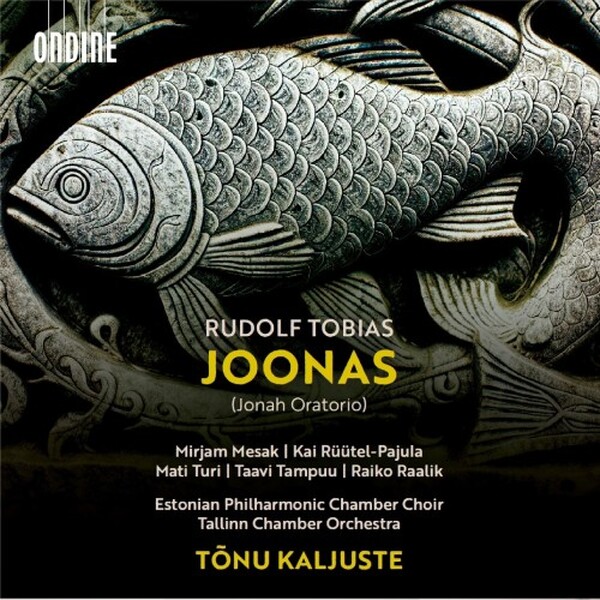
Tobias - Joonas (Jonah)
£23.70
In stock - available for despatch within 1 working day
Despatch Information
This despatch estimate is based on information from both our own stock and the UK supplier's stock.
If ordering multiple items, we will aim to send everything together so the longest despatch estimate will apply to the complete order.
If you would rather receive certain items more quickly, please place them on a separate order.
If any unexpected delays occur, we will keep you informed of progress via email and not allow other items on the order to be held up.
If you would prefer to receive everything together regardless of any delay, please let us know via email.
Pre-orders will be despatched as close as possible to the release date.
Label: Ondine
Cat No: ODE14562D
Format: CD
Number of Discs: 2
Genre: Vocal/Choral
Release Date: 5th December 2025
Contents
Artists
Mirjam Mesak (soprano)Kai Ruutel-Pajula (mezzo-soprano)
Mati Turi (tenor)
Taavi Tampuu (baritone)
Raiko Raalik (bass)
Singers of the Estonian National Opera Boys’ Choir
Estonian Philharmonic Chamber Choir
Tallinn Chamber Orchestra
Conductor
Tonu KaljusteWorks
Joonas (Jonah)Artists
Mirjam Mesak (soprano)Kai Ruutel-Pajula (mezzo-soprano)
Mati Turi (tenor)
Taavi Tampuu (baritone)
Raiko Raalik (bass)
Singers of the Estonian National Opera Boys’ Choir
Estonian Philharmonic Chamber Choir
Tallinn Chamber Orchestra
Conductor
Tonu KaljusteAbout
Tobias began writing his first ideas for the oratorio Jonah between 1904 and 1907. Between 1908 and 1909, during his stays in Paris, Prague, Eichwald and Leipzig, Tobias rewrote, orchestrated and extensively revised the original score. The final score of Jonah was premiered with the composer himself conducting it on 26 November 1909 at St Andrew’s Church in Leipzig. Tobias conducted parts of it in concerts in Germany and Estonia, but it was never performed again in its entirety during the composer’s lifetime. In 1973 the manuscripts of Jonah were examined by the Estonian pianist and musicologist Vardo Rumessen, who wrote that there were notable confusions in Tobias’s manuscripts and thought ‘the technical execution and orchestration of the work was incomplete and sketchy in places’. With the help of the Russian musicologist Yuri Fortunatov, Rumessen decided to reconstruct and re-orchestrate the work by sections and added a new ending. For this new recording conducted by Tõnu Kaljuste, Rudolf Tobias’s original score has been used for the first time, revealing the composer’s original voice in this iconic work in Estonian music.
The Estonian Philharmonic Chamber Choir (EPCC) is one of the bestknown Estonian music ensembles, performing all around the world. The choir’s repertoire extends from Baroque to the music of the 21st century, with a special focus on the Estonian composers, such as Arvo Pärt, Veljo Tormis, Tõnu Kõrvits, and others. The choir has two Grammy Awards, 16 Grammy nominations, Gramophone Award, Diapason d’Or, and Prix Caecilia, among others. BBC Music Magazine and Classic FM have both named the EPCC as one of the 10 best choirs in the world. EPCC has collaborated with many eminent conductors and orchestras including Claudio Abbado, Richard Tognetti, Gustavo Dudamel, the London Symphony Orchestra, the Mahler Chamber Orchestra, the Philip Glass Ensemble, and the Los Angeles Philharmonic, among others. The choir is a welcome guest at prestigious festivals such as the BBC Proms, Festival d’Aix-en-Provence, Salzburg Festspiele, and venues as the Sydney Opera House, Wiener Konzerthaus, the Hong Kong City Hall, Elbphilharmonie in Hamburg, the Kennedy Center in Washington, Carnegie Hall, the Metropolitan Museum and the Lincoln Center in New York, and the Walt Disney Concert Hall in Los Angeles. The EPCC was founded in 1981 by Tõnu Kaljuste, who was the Artistic Director of the choir for twenty years. He was succeeded by Paul Hillier, Daniel Reuss and Kaspars Putniņš. In 2021, Tõnu Kaljuste resumed the role of the Chief Conductor.
Tõnu Kaljuste has gained international recognition with his diverse repertoire, which ranges from operas and classical symphonic works to contemporary music. He has worked with major modernist composers of Northern and Eastern Europe, such as Alfred Schnittke, György Kurtág, Krzysztof Penderecki, Giya Kancheli, and Einojuhani Rautavaara, and is recognised as an expert interpreter and advocate of Estonian composers, including Arvo Pärt, Erkki-Sven Tüür, Tõnu Kõrvits, Veljo Tormis, and Heino Eller. Kaljuste got Grammy for Best Choral Performance for the Arvo Pärt album Adam’s Lament in 2014. His recordings have had a number of Grammy nominations in various categories from opera (David and Bathsheba by the Norwegian composer Ståle Kleiberg) to symphonic music. In 2019 he won the International Classical Music Award for the recording of Arvo Pärt’s symphonies with the NFM Wrocław Philharmonic Orchestra. He is the founder and artistic director of the project theatre Nargen Opera (established in 2004) and has led the Nargenfestival since 2006.
Error on this page? Let us know here
Need more information on this product? Click here