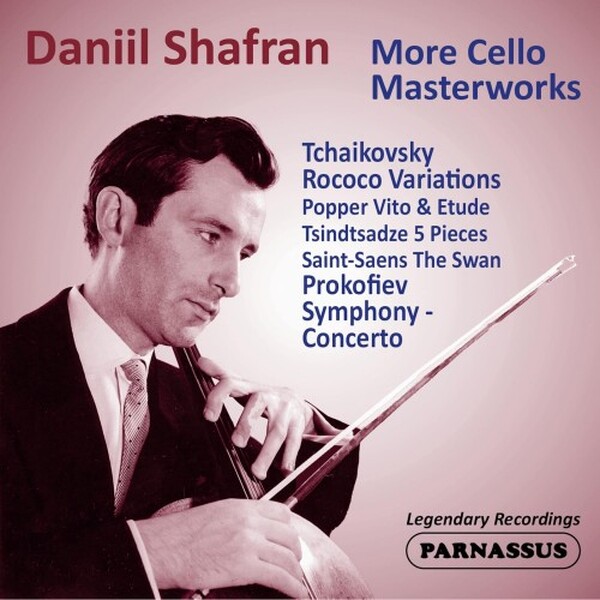
Daniil Shafran: More Cello Masterworks (Tchaikovsky, Prokofiev, etc.)
£10.93
In stock - available for despatch within 1 working day
Despatch Information
This despatch estimate is based on information from both our own stock and the UK supplier's stock.
If ordering multiple items, we will aim to send everything together so the longest despatch estimate will apply to the complete order.
If you would rather receive certain items more quickly, please place them on a separate order.
If any unexpected delays occur, we will keep you informed of progress via email and not allow other items on the order to be held up.
If you would prefer to receive everything together regardless of any delay, please let us know via email.
Pre-orders will be despatched as close as possible to the release date.
Label: Parnassus
Cat No: PACL95016
Format: CD
Number of Discs: 1
Release Date: 3rd October 2025
Contents
Works
Concert Etude, op.55 no.2Spanish Dances, op.54
Carnival of the Animals
Pieces (5) on Folk Themes for cello and piano
Artists
Daniil Shafran (cello)Nina Musinyan (piano)
Anton Ginsburg (piano)
Moscow Philharmonic Orchestra
USSR State Symphony Orchestra
Conductors
Kirill KondrashinGennady Rozhdestvensky
Works
Concert Etude, op.55 no.2Spanish Dances, op.54
Carnival of the Animals
Pieces (5) on Folk Themes for cello and piano
Artists
Daniil Shafran (cello)Nina Musinyan (piano)
Anton Ginsburg (piano)
Moscow Philharmonic Orchestra
USSR State Symphony Orchestra
Conductors
Kirill KondrashinGennady Rozhdestvensky
About
Shafran was born on 13 January 1923 in St Petersburg, then Petrograd/Leningrad, where his father, Boris, was principal cellist in the Leningrad Philharmonic. Studies with his father were followed by lessons with Aleksander Shtrimer (who had also taught Shafran’s father), first at the Special Music School, and then at the conservatoire two years later. Shafran made his concerto debut with the Philharmonic at the age of eleven, performing Tchaikovsky’s ‘Rococo’ Variations conducted by Albert Coates and three years later, in 1937, the same year that he won the All-Union Competition, he recorded the work with Alexander Gauk. His competition prize was a 1630 Amati cello (reputedly), slightly on the small side, that he used for the rest of his life. After his death, it turned out that it was, in fact, probably eighteenth-century German or Bohemian.
“Sebastian Comberti had the best description …like finding the last member of a lost tribe of cellists. His playing takes you right back to a different era.” - Stephen Isserlis
“Comparisons in the Prokofiev are especially telling, Rostropovich is earnest but suave, Shafran more colourful but unremittingly intense. Rozhdestvensky’s mastery of the score is a bonus: this was the period when he made his greatest Prokofiev recordings” - Gramophone
“every bar holds its own brand of magic.” - Gramophone (Tsindzadze)
Error on this page? Let us know here
Need more information on this product? Click here