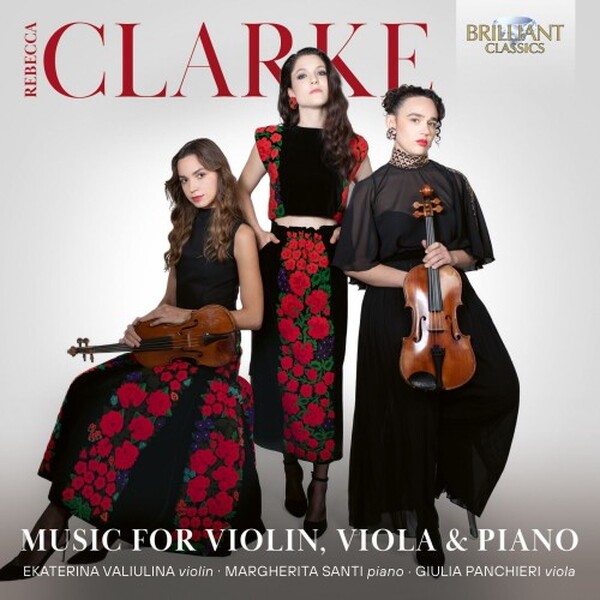
R Clarke - Music for Violin, Viola & Piano
£9.45
In stock - available for despatch within 1 working day
Despatch Information
This despatch estimate is based on information from both our own stock and the UK supplier's stock.
If ordering multiple items, we will aim to send everything together so the longest despatch estimate will apply to the complete order.
If you would rather receive certain items more quickly, please place them on a separate order.
If any unexpected delays occur, we will keep you informed of progress via email and not allow other items on the order to be held up.
If you would prefer to receive everything together regardless of any delay, please let us know via email.
Pre-orders will be despatched as close as possible to the release date.
Label: Brilliant Classics
Cat No: 97575
Format: CD
Number of Discs: 1
Genre: Chamber
Release Date: 10th October 2025
Contents
Works
Chinese PuzzleDumka
I'll bid my heart be still
Lullaby (1909)
Lullaby (1913) - an arrangement of an ancient Irish Folk tune
Midsummer Moon
Morpheus
Passacaglia on an Old English Tune
Viola Sonata
Artists
Ekaterina Valiulina (violin)Giulia Panchieri (viola)
Margherita Santi (piano)
Works
Chinese PuzzleDumka
I'll bid my heart be still
Lullaby (1909)
Lullaby (1913) - an arrangement of an ancient Irish Folk tune
Midsummer Moon
Morpheus
Passacaglia on an Old English Tune
Viola Sonata
Artists
Ekaterina Valiulina (violin)Giulia Panchieri (viola)
Margherita Santi (piano)
About
After decades of neglect, the music of Rebecca Clarke is now receiving its due attention, revealing her individuality as one of the most distinctive of English composers in the generation after Elgar. In her booklet essay, the pianist Margherita Santi recalls her introduction to Clarke and how it immediately sparked ‘deep admiration and wonder’: she finds the roots of Clarke’s style in the music of Franck and Ravel but also the German tradition, paying tribute to the composer’s uncompromisingly individual language.
The Viola Sonata is one of Clarke’s major works, which she wrote in 1918-19 while on tour between Honolulu and Detroit, and for herself to perform. The Sonata has since entered the repertoire of solo violists with an ardent vein of expression and gritty harmony, balancing pastoralism with an unsentimental toughness which makes its occasional windows of visionary mysticism all the more effective. As Margherita Santi remarks, the Sonata evokes ‘a melancholic sensitivity: the gaze of someone who, observing the world, perceives and understands what is unseen, yet chooses not to intervene.’
The other works here are hardly less substantial, despite their smaller scale. Named after the Greek god of sleep, Morpheus (1917) inhabits a world of heavy-lidded rêverie which decorates the viola line with Szymanowskian tracery from the piano. A pair of Lullabies, harmonically simpler, are no less effective and even lovelier; a pair of folk-song settings, one Scottish, the other English, are moving in their simple restraint.
Likewise based on an English folk tune, the Passacaglia returns to the shadowy and stormy world of the Viola Sonata. Midsummer Moon (for violin and piano) is perhaps the closest Clarke came to writing in a popular salon style. Finally, the trio of instruments joins forces in a nostalgic Dumka: a masterful fusion of Czech dance style with Clarke’s own, more forward-looking perspective.
This studio recording, made in Milan in 2024, makes an ideal introduction to the world of Rebecca Clarke, presenting her in the round, through cultivated performances by musicians who feel an affinity for the composer’s trail-blazing and fearless spirit.
Error on this page? Let us know here
Need more information on this product? Click here