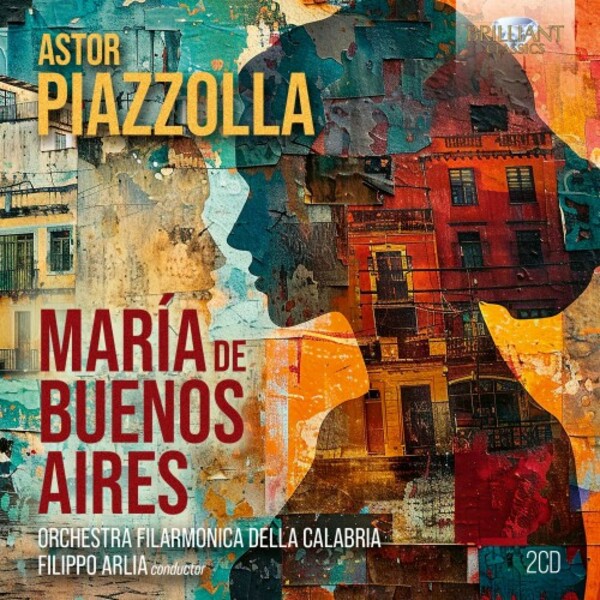
Piazzolla - Maria de Buenos Aires
£11.35
In stock - available for despatch within 1 working day
Despatch Information
This despatch estimate is based on information from both our own stock and the UK supplier's stock.
If ordering multiple items, we will aim to send everything together so the longest despatch estimate will apply to the complete order.
If you would rather receive certain items more quickly, please place them on a separate order.
If any unexpected delays occur, we will keep you informed of progress via email and not allow other items on the order to be held up.
If you would prefer to receive everything together regardless of any delay, please let us know via email.
Pre-orders will be despatched as close as possible to the release date.
Label: Brilliant Classics
Cat No: 96762
Format: CD
Number of Discs: 2
Genre: Opera
Release Date: 12th September 2025
Contents
Artists
Ce Suarez Paz (soprano)Gualtiero Scola
Alberto Maria Munafo
Cesare Chiacchiaretta (bandoneon)
Giovanni Zonno (violin)
Salvatore Russo (electric guitar)
Nico Fuscaldo (piano)
Filippo Arlia (piano)
Orchestra Filarmonica della Calabria
Conductor
Filippo ArliaWorks
Maria de Buenos AiresArtists
Ce Suarez Paz (soprano)Gualtiero Scola
Alberto Maria Munafo
Cesare Chiacchiaretta (bandoneon)
Giovanni Zonno (violin)
Salvatore Russo (electric guitar)
Nico Fuscaldo (piano)
Filippo Arlia (piano)
Orchestra Filarmonica della Calabria
Conductor
Filippo ArliaAbout
The operita tells the symbolic and enigmatic story of María, a woman born “one day when God was drunk” in the slums of Buenos Aires. She becomes a tango singer and a symbol of sensuality and suffering. After her death, María’s shadow wanders through the underworld of the city, encountering surreal characters such as the Duende (a goblin-like narrator) and a chorus of psychoanalysts, construction workers, and thieves. The narrative is abstract, filled with metaphors and mystical elements, portraying María both as a real woman and an allegory for Buenos Aires itself, particularly its tango culture.
Musically, María de Buenos Aires is richly textured, featuring bandoneon (a type of concertina essential in tango music), piano, violin, and voice. Piazzolla’s score breaks traditional tango rhythms and harmonies, pushing the genre into new emotional and intellectual territory.
The work is often interpreted as a meditation on identity, femininity, urban life, and rebirth. Despite its initial mixed reception, it has gained recognition as a groundbreaking piece in 20th-century music and a key work in Piazzolla’s oeuvre. María de Buenos Aires remains a vivid, haunting exploration of the soul of Buenos Aires, where tango is not just a dance or music form, but a poetic expression of passion, loss, and resilience.
Performed by Ce Suarez Paz (soprano, María), Cesare Chiacchiaretta (bandoneon), soloists and the Orchestra Filarmonica della Calabria, conducted by Filippo Arlia.
Error on this page? Let us know here
Need more information on this product? Click here