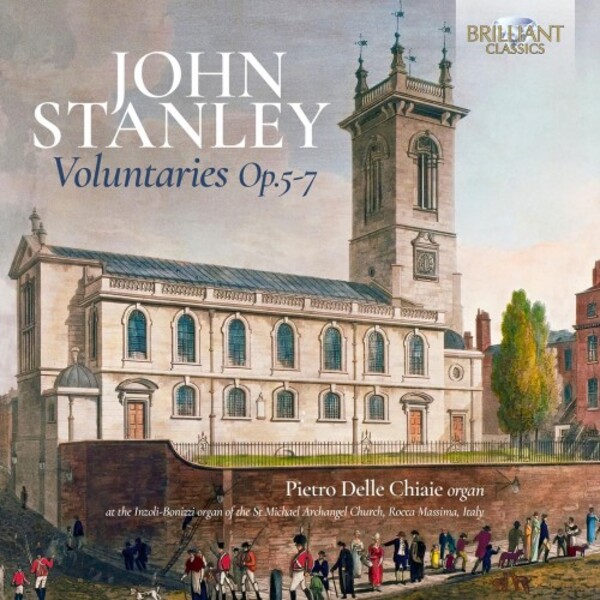
Stanley - Voluntaries, opp. 5-7
£11.35
In stock - available for despatch within 1 working day
Despatch Information
This despatch estimate is based on information from both our own stock and the UK supplier's stock.
If ordering multiple items, we will aim to send everything together so the longest despatch estimate will apply to the complete order.
If you would rather receive certain items more quickly, please place them on a separate order.
If any unexpected delays occur, we will keep you informed of progress via email and not allow other items on the order to be held up.
If you would prefer to receive everything together regardless of any delay, please let us know via email.
Pre-orders will be despatched as close as possible to the release date.
Label: Brilliant Classics
Cat No: 97230
Format: CD
Number of Discs: 2
Genre: Instrumental
Release Date: 15th August 2025
Contents
Artists
Pietro Delle Chiaie (organ)Works
Organ Voluntaries (10), op.5Organ Voluntaries (10), op.6
Organ Voluntaries (10), op.7
Artists
Pietro Delle Chiaie (organ)About
As a musician whose primary responsibilities were liturgical, John Stanley was required to accompany the service music every Sunday, and also to improvise voluntaries at various points in the service. A voluntary was a piece improvised extemporaneously and, prior to the 19th century, in the Church of England there were two principal forms of voluntary. These were a First Voluntary – generally an introduction and a movement or two for solo stops such as the trumpet or cornet – placed between the psalms and the first lesson at Morning and Evening Prayer, and a Second Voluntary – generally an introduction and fugue – at the end of the service. John Stanley’s primary responsibility in his sixty-three years as organist at these various churches, was to improvise a voluntary before the first lesson (comprising an introduction and an additional movement or two for the solo stops) and an introduction and fugue at the end of the service. Stanley’s improvisations were reportedly so fine that on Sundays none other than Handel himself, who attended St George’s, Hanover Square, would sometimes leave church early and rush over to the Temple Church to hear Stanley’s final voluntary.
Most voluntaries were never written down as compositions, and very few voluntaries for organ were published in England before Stanley’s Op.5 of 1748. But written-out voluntaries did serve two main purposes: first, they were often used for recital purposes, as for example when organists like Stanley played at the dedication of a new instrument; second, they were widely used as exercises for apprentices or organ students, or for church organists new to their roles. Some of the manuscript collections produced for this purpose have survived. One important collection of this kind is the so-called Southgate Manuscript, a collection of 64 voluntaries in the library of the Royal College of Organists in London. This seems to have been compiled around the year 1750 in order to instruct choristers of the Chapel Royal who were learning the organ. This manuscript contains several of the early organ works of John Stanley.
Error on this page? Let us know here
Need more information on this product? Click here