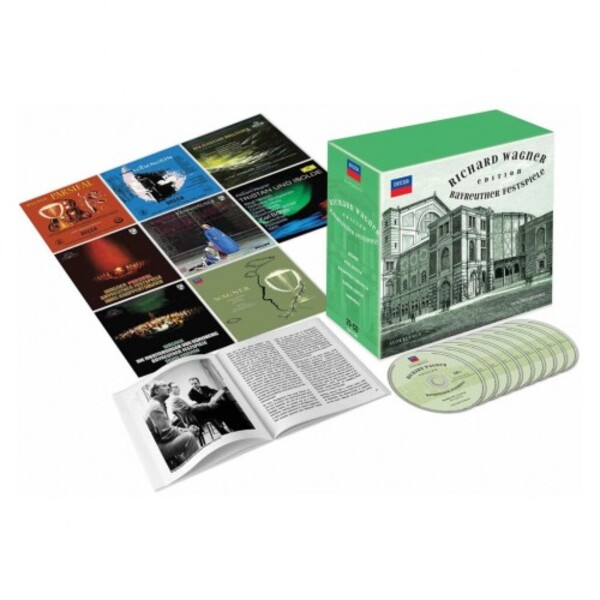
The Wagner Edition: Bayreuth Festival
£123.45 £98.76
save £24.69 (20%)
special offer ending 01/01/2026
In stock - available for despatch within 1 working day
Despatch Information
This despatch estimate is based on information from both our own stock and the UK supplier's stock.
If ordering multiple items, we will aim to send everything together so the longest despatch estimate will apply to the complete order.
If you would rather receive certain items more quickly, please place them on a separate order.
If any unexpected delays occur, we will keep you informed of progress via email and not allow other items on the order to be held up.
If you would prefer to receive everything together regardless of any delay, please let us know via email.
Pre-orders will be despatched as close as possible to the release date.
Label: Eloquence
Cat No: ELQ4847580
Format: CD
Number of Discs: 25
Genre: Opera
Release Date: 6th June 2025
Contents
Works
Der fliegende Hollander (The Flying Dutchman)Die Meistersinger von Nurnberg
Lohengrin
Parsifal
Tannhauser
Tristan und Isolde
Artists
Hannelore Bode (soprano)Martha Modl (soprano)
Birgit Nilsson (soprano)
Anja Silja (soprano)
Eleanor Steber (soprano)
Astrid Varnay (soprano)
Grace Bumbry (mezzo-soprano)
Irene Dalis (mezzo-soprano)
Christa Ludwig (mezzo-soprano)
Jean Cox (tenor)
Gerhard Stolze (tenor)
Jess Thomas (tenor)
Josef Traxel (tenor)
Wolfgang Windgassen (tenor)
Klaus Hirte (baritone)
Eberhard Wachter (baritone)
Hans Hotter (bass-baritone)
George London (bass-baritone)
Hermann Uhde (bass-baritone)
Karl Ridderbusch (bass)
Martti Talvela (bass)
Ludwig Weber (bass)
Chor und Orchester der Bayreuther Festspiele
Conductors
Karl BohmJoseph Keilberth
Hans Knappertsbusch
Wolfgang Sawallisch
Silvio Varviso
Works
Der fliegende Hollander (The Flying Dutchman)Die Meistersinger von Nurnberg
Lohengrin
Parsifal
Tannhauser
Tristan und Isolde
Artists
Hannelore Bode (soprano)Martha Modl (soprano)
Birgit Nilsson (soprano)
Anja Silja (soprano)
Eleanor Steber (soprano)
Astrid Varnay (soprano)
Grace Bumbry (mezzo-soprano)
Irene Dalis (mezzo-soprano)
Christa Ludwig (mezzo-soprano)
Jean Cox (tenor)
Gerhard Stolze (tenor)
Jess Thomas (tenor)
Josef Traxel (tenor)
Wolfgang Windgassen (tenor)
Klaus Hirte (baritone)
Eberhard Wachter (baritone)
Hans Hotter (bass-baritone)
George London (bass-baritone)
Hermann Uhde (bass-baritone)
Karl Ridderbusch (bass)
Martti Talvela (bass)
Ludwig Weber (bass)
Chor und Orchester der Bayreuther Festspiele
Conductors
Karl BohmJoseph Keilberth
Hans Knappertsbusch
Wolfgang Sawallisch
Silvio Varviso
About
This survey of Wagner’s mature operas, excluding the Ring, takes the listener from Parsifal in 1951 under Hans Knappertsbusch, through to Die Meistersinger von Nürnberg under Silvio Varviso in 1974. Both the 1951 Parsifal and Lohengrin from two years later, under Joseph Keilberth, were captured in ‘ffrr’ mono by the legendary Decca team of engineers under the supervision of John Culshaw. Decca continued to work at Bayreuth until 1955, capturing Der fliegende Holländer, also under Keilberth, in a superb example of Decca’s early stereo sound.
The casts were often youthful, but coached by the Festival co-director Wieland Wagner into an intense engagement with text and music. Performances here by Wolfgang Windgassen, Hermann Uhde, Ludwig Weber, Birgit Nilsson and others reach a special level of long-breathed intensity almost impossible to sustain under studio conditions.
None of the conductors involved had worked at Bayreuth before the war. Keilberth, Wolfgang Sawallisch and Karl Böhm all engaged with Wieland in finding a new, flowing but dramatically inflected style in Wagner. Something of this New Bayreuth style also infuses Knappertsbusch’s 1962 Parsifal with a unique combination of mystery and rapture. The set includes a previously unpublished radio interview with Irene Dalis and George London, the Kundry and Amfortas in that performance.
Like Knappertsbusch’s Parsifal, the Tristan und Isolde under Böhm in 1966 was rapidly recognised as a classic of the gramophone and has hardly been out of print since then, but it is reissued here with the rehearsal sequence included on the final LP of the original set. This ‘Original Covers’ box also includes a booklet essay by Peter Quantrill which explores the history of post-war Bayreuth and the circumstances of each recording.
“With the passage of time, nearly everything Knappertsbusch does begins to seem eminently right. Glowing images are conjured up; climaxes swell slowly and shatter us at their peak. The cast is flawless.” – High Fidelity, November 1961 (Parsifal, 1951)
“Arguably the finest live recording ever made in the Festspielhaus, with outstanding singing from Jess Thomas as Parsifal and Hans Hotter as Gurnemanz … there is no sense of squareness or length, so intense is the concentration of the performance, its spiritual quality.” – Penguin Guide (Parsifal, 1962)
“The core of Parsifal recordings is still the two Bayreuth sets, from 1951 and 1962, under Knappertsbusch … A sense of special occasion permeates the earlier … the later is less solemn and devotional, more present both in musical detail and in its dramatic detail.” – Opera on Record (Parsifal)
“Very persuasive, notably in the Venusberg scene where Bumbry is a superb, sensuous Venus and Windgassen… is a fine, heroic Tannhäuser … the atmosphere of the Festspielhaus is vivid and compelling throughout.” – Penguin Guide (Tannhäuser)
“The performance glows with intensity from beginning to end … an almost unmatchable cast … Nilsson sings the Liebestod as though she was starting out afresh … rising to an orgasmic climax and bringing a heavenly pianissimo on the final rising octave.” – Penguin Guide (Tristan und Isolde)
“A quality of dry brilliance quite unlike the normal fat Wagner sound … Windgassen is excellent throughout … Nilsson is transformed … Ludwig’s Brangäne is a perfect foil … Böhm’s flow and surge are completely captivating.” – Opera on Record (Tristan und Isolde)
“Easily the best all-round cast of any recorded versions.” – High Fidelity, January 1967 (Tristan und Isolde)
“Böhm impresses more with the firmness, logic and self-effacing qualities of his interpretation … unassailable in its rightness.” – Stereo Review, February 1967 (Tristan und Isolde)
“Keilberth, in charge of the superb Bayreuth orchestra, shapes and controls the performance magnificently … Varnay contributes a thrilling Ortrud … [Windgassen’s] Lohengrin on these discs is superb.” – Opera on Record (Lohengrin)
“Extraordinarily well recorded … Varnay gives a performance of enormous impact … Uhde is really outstanding.” – High Fidelity, July 1954 (Lohengrin)
“Working with a superior cast and a magnificent chorus and orchestra, [Keilberth] has been able to weld these forces into an inspired artistic unity.” – The Record Guide, 1955 (Lohengrin)
“[Lohengrin] is brought to life with a degree of expertness not often achieved either on stage or in the studio. Keilberth is a penetrating governor of proceedings.” – High Fidelity, November 1961 (Lohengrin)
“Hermann Uhde as the Dutchman and Ludwig Weber as Daland, a great partnership which can hardly be overpraised … the early stereo recording has a real flavour of the Festspielhaus’s glorious acoustic.” – Opera on Record (Der fliegende Holländer)
“[Varnay’s] grasp of character is so intellectually complete, her singing so surely to the musical point, that not even the continual threat of tremolo can seriously prejudice the effectiveness of her performance. What a wonderful artist she is!” – High Fidelity, March 1957 (Der fliegende Holländer)
“The sound is really astonishing: full, weighty, admirably detailed, beautifully spaced out, and altogether more impressive than the original mono release.” – High Fidelity, January 1971 (Der fliegende Holländer)
“The reading has a brooding, driving power singularly appropriate to the drama.” – High Fidelity, May 1983 (Der fliegende Holländer)
“Seemingly unfazed by the monumentalism of Wagner’s most human music drama, Varviso guides it with a light touch, favouring sensible tempi and light textures, and allowing the drama to develop convincingly through the actions of believable people.” – Stereo Review, May 1976 (Die Meistersinger von Nürnberg)
“The playing is admirably vigorous and weighty, and often surprisingly elegant … Sotin is in magnificent voice [as Pogner] … Hirte is a surprising and refreshing Beckmesser, lively, youthful.” – Opera on Record (Die Meistersinger von Nürnberg)
Error on this page? Let us know here
Need more information on this product? Click here