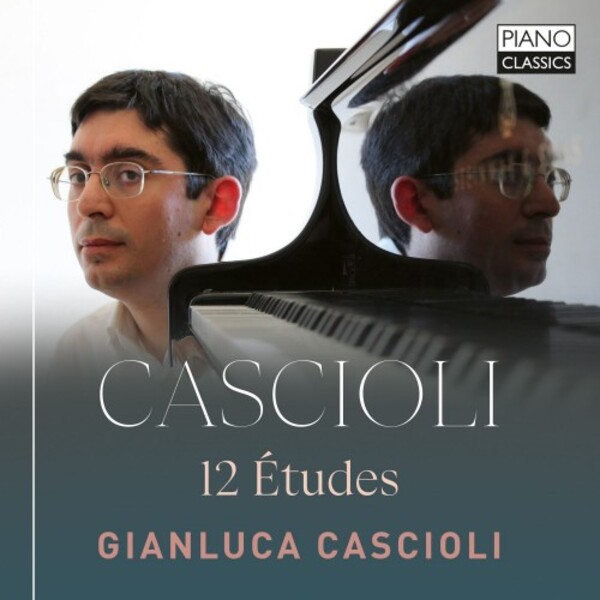
Cascioli - 12 Etudes
£15.15
In stock - available for despatch within 1 working day
Despatch Information
This despatch estimate is based on information from both our own stock and the UK supplier's stock.
If ordering multiple items, we will aim to send everything together so the longest despatch estimate will apply to the complete order.
If you would rather receive certain items more quickly, please place them on a separate order.
If any unexpected delays occur, we will keep you informed of progress via email and not allow other items on the order to be held up.
If you would prefer to receive everything together regardless of any delay, please let us know via email.
Pre-orders will be despatched as close as possible to the release date.
Label: Piano Classics
Cat No: PCL10332
Format: CD
Number of Discs: 1
Genre: Instrumental
Release Date: 13th June 2025
Contents
Artists
Gianluca Cascioli (piano)About
Gianluca Cascioli wrote these 12 piano Études, in two volumes of six, between November 2020 and July 2023, before taking them into the studio in September 2023. Followers of the pianist’s recorded output, on both DG and Piano Classics, will anticipate the fastidious articulation, sculpted rhythm and highly coloured tone of his Beethoven, his Berg and Boulez on disc.
Albums of his music for cello and for solo piano have also given notice of Cascioli’s individual voice as a composer. Here is a composer-pianist who has Debussy, Busoni and Liszt under his fingers, and a full command of both diatonic and chromatic harmony. The pieces speak of our own time, inevitably inflected by all that has preceded them.
Each of the 12 studies recorded here has a dedicatee and is in some way inspired by an aspect of their personality. The music of Frank Zappa inspired no.2, and no.4 is a retrograde canon built on a cantus firmus derived from John Lennon’s song War is Over.
Thus, while the technique underlying their construction is formidably complex (and fully outlined in the booklet essay) the expression is quite direct. As Cascioli remarks, ‘The idea of technique being concealed is essential to me. I do not admire technique when it is showcased, but only when it conveys a message.’
Passing passages bear certain resemblances to Chopin, to Messiaen and to Ligeti: all composers who have extended piano techniques in their time. No.7, for instance, is ‘an amusement between white and black keys, somewhat akin to Chopin’s op.10 no.5.’ Étude no.8 unexpectedly ventures into minimalism, with ostinato rhythms that gradually phase out of sync. Each successive Étude presents new challenges to the pianist and new avenues of exploration to the inquisitive listener.
Error on this page? Let us know here
Need more information on this product? Click here