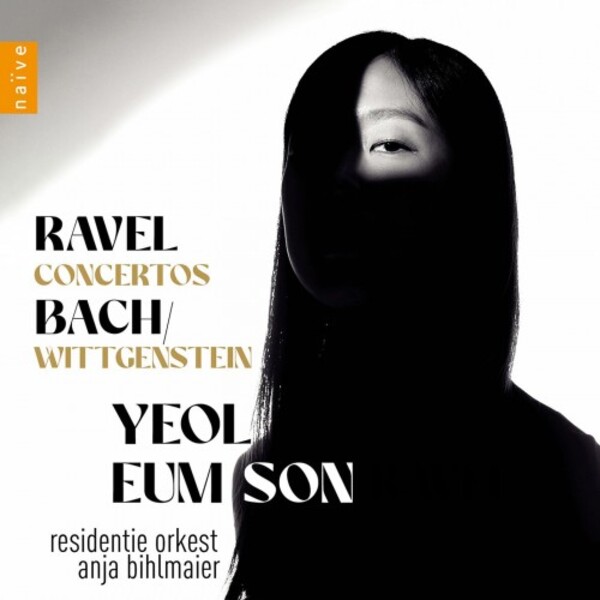
Ravel - Piano Concertos + JS Bach (arr. Wittgenstein)
£14.20
In stock - available for despatch within 1 working day
Despatch Information
This despatch estimate is based on information from both our own stock and the UK supplier's stock.
If ordering multiple items, we will aim to send everything together so the longest despatch estimate will apply to the complete order.
If you would rather receive certain items more quickly, please place them on a separate order.
If any unexpected delays occur, we will keep you informed of progress via email and not allow other items on the order to be held up.
If you would prefer to receive everything together regardless of any delay, please let us know via email.
Pre-orders will be despatched as close as possible to the release date.
Label: Naive
Cat No: V8447
Format: CD
Number of Discs: 1
Release Date: 16th May 2025
Contents
Works
Flute Sonata in E flat major, BWV1031The Well-Tempered Clavier Book 1, BWV846-869
Piano Concerto in G major
Artists
Yeol Eum Son (piano)Residentie Orkest The Hague
Conductor
Anja BihlmaierWorks
Flute Sonata in E flat major, BWV1031The Well-Tempered Clavier Book 1, BWV846-869
Piano Concerto in G major
Artists
Yeol Eum Son (piano)Residentie Orkest The Hague
Conductor
Anja BihlmaierAbout
Led by their musical director Anja Bihlmaier, the musicians of the Residentie Orkest The Hague offer the pianist (born in 1986) lyrical phrasing and beautiful nocturnal atmospheres.
For the Korean pianist, Ravel’s Concertos evokes the horrors of the Great War as much as a moment in her country’s history, the wars that shook the European continent at the beginning of the 20th century echoing her nation’s first independence movements.
In the form of a postlude, the four pieces by Johann Sebastian Bach presented here in arrangements for the left hand alone by Paul Wittgenstein, form more than an escape. They constitute, after the horrors of the destruction, the real moment of reparation.
A few months after finishing his famous Boléro, Maurice Ravel set himself a new challenge: to bring together the two instruments that have always been at the heart of his main occupations, the piano and the orchestra. Two commissioners would ultimately help him: Serge Koussevitzky, the head of the Boston Symphony Orchestra and ardent advocate of the music of his time, for whom Ravel would conceive the Concerto in G major, and Paul Wittgenstein, a pianist born in Vienna in 1887 who, since losing his right hand on the front during a Russian offensive on Poland, had worked to develop the repertoire dedicated to the left hand alone.
From the imagination of the French composer would emerge two works, at the same time diametrically opposed and complementary. Luminous, light, with a quasi-chamber music feel, resolutely classically inspired in its three well-defined movements, the Concerto in G major recalls Mozart’s purity, while the Concerto in D major in a single movement seems dark, harsh, implacable, like an echo of the final collapse of La Valse, conceived ten years earlier. The soloist - with his or her left hand alone - must confront Everest, an orchestra almost three times larger than in the other concerto, and almost inhuman technical challenges.
The hymn to life that seems to be the Concerto in G major, a work begun before and completed after the other, is perhaps an illusion; the pain is in reality transfigured, in the evocation of remembrances throughout the sublime Adagio assai, or by the intoxication of hope in the sparkling final Presto.
Error on this page? Let us know here
Need more information on this product? Click here