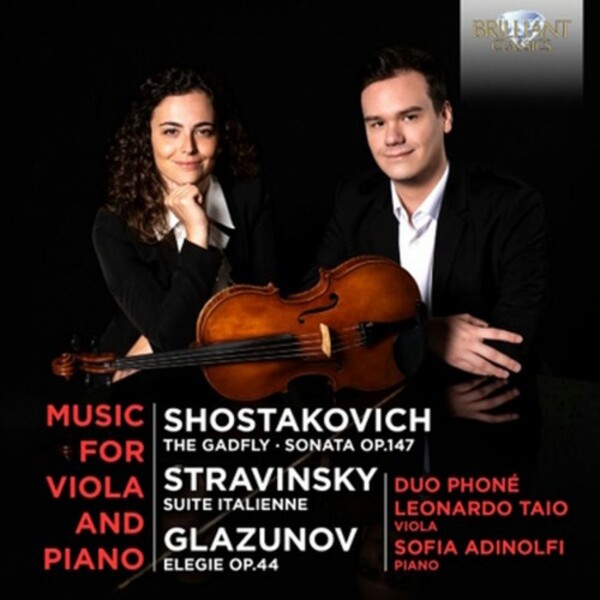
Shostakovich, Stravinksy, Glazunov - Music for Viola and Piano
£9.45
In stock - available for despatch within 1 working day
Despatch Information
This despatch estimate is based on information from both our own stock and the UK supplier's stock.
If ordering multiple items, we will aim to send everything together so the longest despatch estimate will apply to the complete order.
If you would rather receive certain items more quickly, please place them on a separate order.
If any unexpected delays occur, we will keep you informed of progress via email and not allow other items on the order to be held up.
If you would prefer to receive everything together regardless of any delay, please let us know via email.
Pre-orders will be despatched as close as possible to the release date.
Label: Brilliant Classics
Cat No: 96874
Format: CD
Number of Discs: 1
Genre: Chamber
Release Date: 23rd May 2025
Contents
About
The late 1960s marked the beginning of the composer’s final, dark and penetrating stylistic period, and his Sonata for viola and piano was his last composition and the only piece he never heard, its premiere only coming several weeks after his death. Dedicated to Fyodor Druzhinin, violist of Moscow’s Beethoven Quartet, is one of the most unique and oft played sonatas in the viola repertoire. Written in three movements, there is no tonal centre or tonality.
Igor Stravinsky’s Suite italienne has its origins in the composer’s ballet score Pulcinella, based on music newly discovered at the time and believed to be from the pen of Italian composer Giovanni Battista Pergolesi (some of it was later discovered to be by other baroque composers such as Domenico Gallo and Carlo Monza).
The resulting “neoclassical” style afforded Stravinsky an objectivity and emotional detachment, far removed from late-Romantic sentimentality or the dramatic, allusive style in the music of his earlier Russian period. He prepared the Suite italienne for violin and piano from the Pulcinella ballet music with the help of his recital partner violinist Samuel Dushkin. In Leonardo Taio’s own viola arrangement, based on the 1947 Boosey & Hawkes edition (ed. Dushkin), the piano part remains unchanged while the viola part is adapted to exploit the instrument’s timbral potential.
At the turn of the 20th century Alexander Glazunov was widely regarded as the greatest living Russian composer. His Elégie in G minor, op.44, is an original viola and piano work, dedicated to his friend Franz Hildebrand.
In this delightful piece Glazunov successfully reconciles Russian nationalism and cosmopolitanism. Although he was the direct successor of Balakirev’s nationalism, he tended towards Borodin’s epic grandeur while absorbing a range of other influences that included Rimsky-Korsakov’s orchestral virtuosity, Tchaikovsky’s lyricism and Taneyev’s contrapuntal skill.
Duo Phoné:
- Leonardo Taio (viola)
- Sofia Adinolfi (piano)
Error on this page? Let us know here
Need more information on this product? Click here