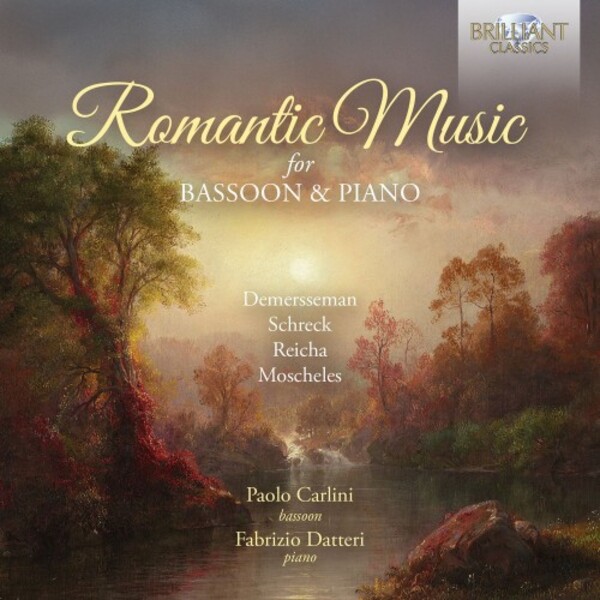
Romantic Music for Bassoon & Piano
£9.45
In stock - available for despatch within 1 working day
Despatch Information
This despatch estimate is based on information from both our own stock and the UK supplier's stock.
If ordering multiple items, we will aim to send everything together so the longest despatch estimate will apply to the complete order.
If you would rather receive certain items more quickly, please place them on a separate order.
If any unexpected delays occur, we will keep you informed of progress via email and not allow other items on the order to be held up.
If you would prefer to receive everything together regardless of any delay, please let us know via email.
Pre-orders will be despatched as close as possible to the release date.
Label: Brilliant Classics
Cat No: 97503
Format: CD
Number of Discs: 1
Genre: Chamber
Release Date: 11th April 2025
Contents
Works
Introduction et Polonaise, op.30Grande Sonate concertante in B flat major, op.34
Bassoon Sonata in B flat major
Bassoon Sonata in E flat major, op.9
Artists
Paolo Carlini (bassoon)Fabrizio Datteri (piano)
Works
Introduction et Polonaise, op.30Grande Sonate concertante in B flat major, op.34
Bassoon Sonata in B flat major
Bassoon Sonata in E flat major, op.9
Artists
Paolo Carlini (bassoon)Fabrizio Datteri (piano)
About
Ignaz (Isaac) Moscheles (1794–1870) belongs to that series of pianist-composers who emphasised ‘physiological’ characteristics of the instrument, transmitting paroxysmal force into it and revolutionising its technique beyond what was inherited from the harpsichord. He sets his Grande Sonate concertante, op.34, on the piano in a very virtuosic manner, alternating between bassoon–piano dialogue and a predominance of the latter. The opening Allegro moderato is marked, with passionate moments; an Andante doloroso follows, ending with a piano cadenza. Even in the extended concluding Allegro molto, the piano has a very demanding part that enhances a heated expressiveness.
Antonín Reicha (1770–1836) was a contemporary of Beethoven, and prominent in his catalogue are compositions for wind instruments, with their imaginative and innovative exploitation of their technical and timbral possibilities, effectively surpassing the classical sonata in favour of formal and expressive cues that were a source of inspiration for Romantic sentiment. His Sonata for bassoon and piano clearly recalls – in its formal organisation of the musical material – Beethoven’s sonatas for instrumental duo. It is on the level of poetics, however, that Reicha goes further, creating moments of great melodic expressiveness.
Error on this page? Let us know here
Need more information on this product? Click here