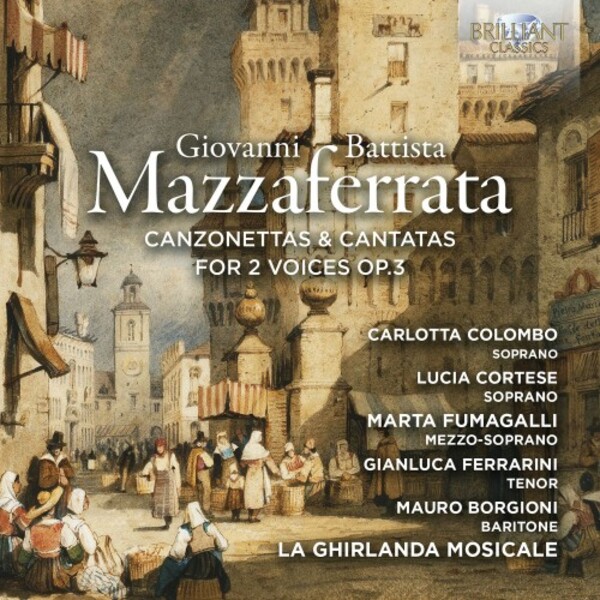
Mazzaferrata - Canzonettas & Cantatas for 2 Voices, op.3
£9.45
In stock - available for despatch within 1 working day
Despatch Information
This despatch estimate is based on information from both our own stock and the UK supplier's stock.
If ordering multiple items, we will aim to send everything together so the longest despatch estimate will apply to the complete order.
If you would rather receive certain items more quickly, please place them on a separate order.
If any unexpected delays occur, we will keep you informed of progress via email and not allow other items on the order to be held up.
If you would prefer to receive everything together regardless of any delay, please let us know via email.
Pre-orders will be despatched as close as possible to the release date.
Label: Brilliant Classics
Cat No: 96504
Format: CD
Number of Discs: 1
Genre: Vocal/Choral
Release Date: 11th April 2025
Contents
Works
Mazzaferrata, Giovanni Battista
Canzonette e cantate a due voci, op.3Artists
Carlotta Colombo (soprano)Lucia Cortese (soprano)
Marta Fumagalli (mezzo-soprano)
Gianluca Ferrarini (tenor)
Mauro Borgioni (baritone)
La Ghirlanda Mosicale
Works
Mazzaferrata, Giovanni Battista
Canzonette e cantate a due voci, op.3Artists
Carlotta Colombo (soprano)Lucia Cortese (soprano)
Marta Fumagalli (mezzo-soprano)
Gianluca Ferrarini (tenor)
Mauro Borgioni (baritone)
La Ghirlanda Mosicale
About
The Opus 3 set was published in Bologna in 1668 and dedicated to Count Angelo Porro of Milan, and this album features 6 of the 11 compositions comprising the collection: Libertà in Amor, Che impertinente usanza and Che t’ho fatto o Speranza are canzonettas; Angosciosi deliri and Tormenti, che volete? are more serious songs; and Rifiuto d’Amor is a cantata.
Formally, the compositions consist of several sections played attacca, featuring all the main baroque genres such as arias in duet, arias for solo voice with basso continuo, secco and accompanied recitatives and more ‘theatrical’ recitation. Mazzaferrata’s compositional technique achieves both expressive and textural contrasts between the sections. In accordance with the seconda prattica, there is a predominant ‘concerting’ (dialoguing) of the voices (even with the active presence of the instrumental bass) making use of counterpoint and imitation, canon, stretta and exchange of motives. The composer also employs rhetorical figures (theory of the affections) and madrigalisms (word-painting) in all of the works. The vocal parts are virtuosic, foreshadowing bel canto-type colouratura, featuring melismas and large leaps.
Mazzaferrata’s music gives an impression of versatility: on the one hand these compositions were written well before 1680, according to the rhetorical rules set out by Baldassare Castiglione in Il libro del Cortegiano including the effortlessness (‘sprezzatura’) of Caccini and Peri and the influence of Monteverdi; yet there is innovation in fragments amounting to near late-Baroque with Bachian basso movimentato. The composer therefore constitutes a bridge between the past and the future.
Error on this page? Let us know here
Need more information on this product? Click here