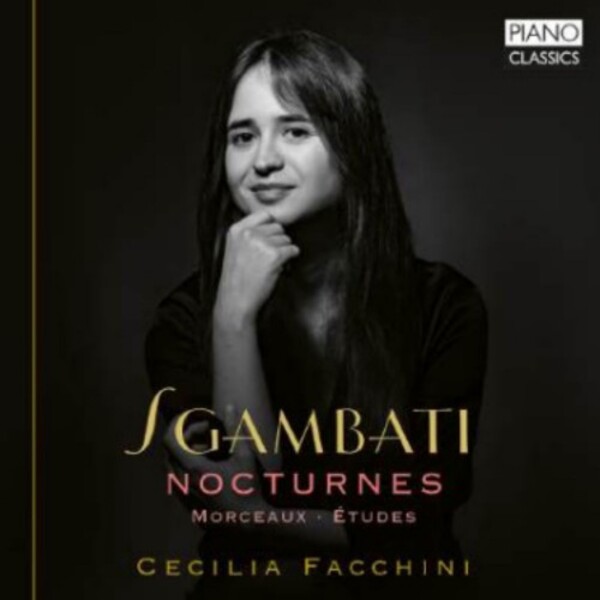
Sgambati - Nocturnes, Morceaux, Etudes
£15.15
In stock - available for despatch within 1 working day
Despatch Information
This despatch estimate is based on information from both our own stock and the UK supplier's stock.
If ordering multiple items, we will aim to send everything together so the longest despatch estimate will apply to the complete order.
If you would rather receive certain items more quickly, please place them on a separate order.
If any unexpected delays occur, we will keep you informed of progress via email and not allow other items on the order to be held up.
If you would prefer to receive everything together regardless of any delay, please let us know via email.
Pre-orders will be despatched as close as possible to the release date.
Label: Piano Classics
Cat No: PCL10319
Format: CD
Number of Discs: 1
Genre: Instrumental
Release Date: 14th March 2025
Contents
About
When Richard Wagner visited Rome in 1876, he was so impressed by Sgambati’s two piano quintets that he introduced him to Ludwig Strecker – head of Schott in Mainz – and invited the publisher to bring Sgambati to the attention of the wider musical world, since in Rome ‘he is not in the right place’. Although he was highly regarded by the likes of Wagner and Liszt, Sgambati was almost totally forgotten after his death in 1914. The Piano Classics label has played a leading part in the composer’s renaissance, with an ongoing survey on record of the composer’s complete piano music.
‘I am a pianist and a music populariser,’ says Cecilia Facchini. ‘I have always seen music as the best form of language through which I can express myself. When I play I try to establish a deep and intimate communication with the listener.’ She has applied herself to reviving Sgambati as both a scholar and a performer, and on this new album she makes a personal selection which is designed to reflect various aspects of the composer, as a teacher, an arranger, and an original tone-poet.
Inevitably, the album opens with the Mélodie de Gluck which transcribes the Dance of the Blessed Spirits from Orfeo ed Euridice for the 19th-century keyboard. In her booklet essay, Facchini remarks that the Nocturnes are among ‘the most interesting of Sgambati’s compositions. Composed between 1873 and 1897, these pieces require a refined use of the touch and pedalling to create contrasting musical atmospheres. The heritage of Liszt’s pianism and style of composition seems to be evident even on first listening.’ She also includes a set of Concert Etudes, op.10, to illustrate Sgambati’s importance as a composer-pedagogue, whose didactic works were reprinted in many significant ‘piano methods’.
A violinist who played Beethoven with Sgambati remarked that ‘his piano technique was impeccable, clear and pure even in the most difficult passages. His sound was smooth and harmonious, his use of pedals as accurate as ever. Gifted with a touch of great beauty, his fingers could sing on the keyboard.’ In this regard, Cecilia Facchini is a worthy successor and advocate for Sgambati in the 21st century.
Error on this page? Let us know here
Need more information on this product? Click here