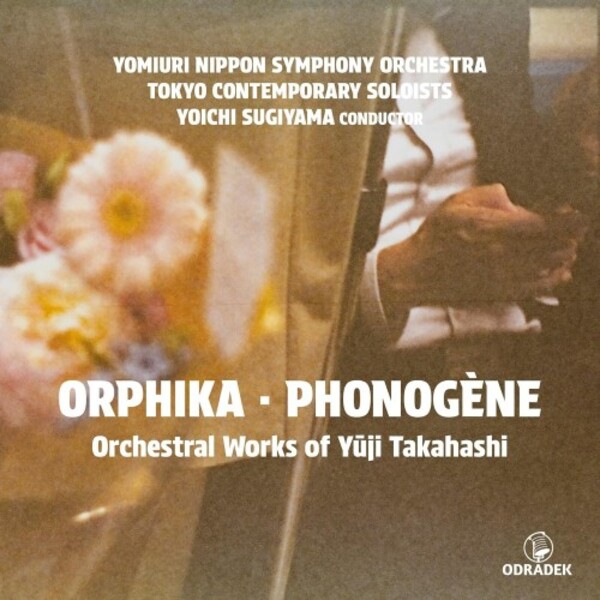
Takahashi - Orphika, Phonogene: Orchestral Works
£18.95
In stock - available for despatch within 1 working day
Despatch Information
This despatch estimate is based on information from both our own stock and the UK supplier's stock.
If ordering multiple items, we will aim to send everything together so the longest despatch estimate will apply to the complete order.
If you would rather receive certain items more quickly, please place them on a separate order.
If any unexpected delays occur, we will keep you informed of progress via email and not allow other items on the order to be held up.
If you would prefer to receive everything together regardless of any delay, please let us know via email.
Pre-orders will be despatched as close as possible to the release date.
Label: Odradek Records
Cat No: ODRCD459
Format: CD
Number of Discs: 2
Genre: Orchestral
Release Date: 14th February 2025
Contents
Works
Bridges IIIBridges II
Gandharva
Le double de Paganini
Like Swans Leaving the Lake
Orphika
Phonogene
Phonourloupes
Tori mo tsukai ka
Artists
Yomiuri Nippon Symphony OrchestraTokyo Contemporary Soloists
Conductor
Yoichi SugiyamaWorks
Bridges IIIBridges II
Gandharva
Le double de Paganini
Like Swans Leaving the Lake
Orphika
Phonogene
Phonourloupes
Tori mo tsukai ka
Artists
Yomiuri Nippon Symphony OrchestraTokyo Contemporary Soloists
Conductor
Yoichi SugiyamaAbout
Covering 57 years of Takahashi's creative activity, the works represented in this compilation span a period in which his musical, aesthetic and political positions underwent radical change.
The earliest piece, Phonogène (1962), reflects the intellectual rigour and complexity of Takahashi's music at this period, especially his use of mathematical generative processes - an interest the composer shared with Xenakis, whom he had met in Japan the previous year.
Written in Paris, where Takahashi was now studying with Xenakis, Bridges II (1965) includes microtonal deviations of pitch. In Bridges III (1968), he went one step further, requesting that all instruments be tuned to A = 450 Hz, but since this can cause string breakage, this recording adopts 442 Hz while preserving the intended pitch ratios. Takahashi did not preserve the scores of either of these works, so this recording is an exclusive opportunity to hear works recovered for this performance with the assistance of Sumihisa Arima and Yumiko Meguri.
Orphika (1969), whose title refers to the ancient Orphic religion, uses mathematical procedures based on probability, with its basis in five types of sound movement (glissando, oscillation, staccato, tremolo, legato).
By 1986, the year of Le double de Paganini, Takahashi's political and musical outlook had undergone radical overhaul, and the work derives from a number of Paganini's 24 Caprices for violin, and features clearly tonal/modal sonorities.
Tori mo tsukai ka (1993) reflects another aspect of the composer's later manner, his interest in traditional Asiatic and, in this instance, specifically Japanese music. Its scoring, for katari narrator playing the three-stringed shamisen and orchestra, is influenced by the Myoon Junigaku festival.
The stimulus for the opening of Like Swans Leaving the Lake (1995) is also far removed from the abstractions of the composer's early work: the fluttering of a swan's wings, graphically impersonated by the 'ricochet' effects in the accordion.
The most recent work in this collection, Phonourloupes (2019) is heard here in its premiere performance.
This wide-ranging programme represents an essential insight into a profoundly significant figure of 20th-century and contemporary music, and is performed by a host of outstanding musicians devoted to the meticulous and sensitive interpretation of Takahashi's extraordinary output.
Error on this page? Let us know here
Need more information on this product? Click here