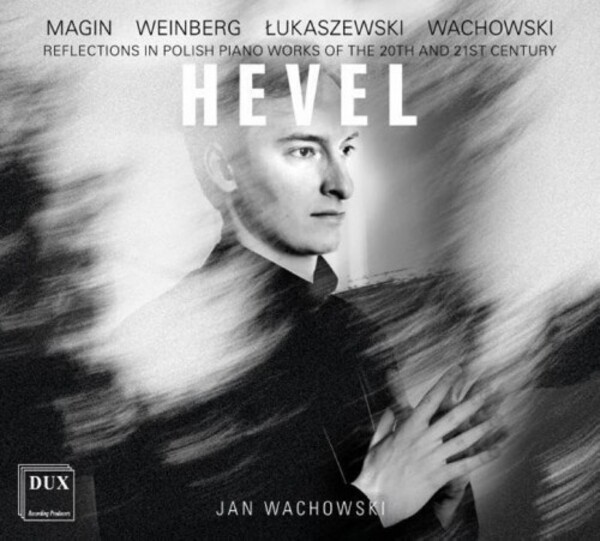
Hevel: Reflections in Polish Piano Works of the 20th and 21st Century
£14.20
In stock - available for despatch within 1 working day
Despatch Information
This despatch estimate is based on information from both our own stock and the UK supplier's stock.
If ordering multiple items, we will aim to send everything together so the longest despatch estimate will apply to the complete order.
If you would rather receive certain items more quickly, please place them on a separate order.
If any unexpected delays occur, we will keep you informed of progress via email and not allow other items on the order to be held up.
If you would prefer to receive everything together regardless of any delay, please let us know via email.
Pre-orders will be despatched as close as possible to the release date.
Label: Dux
Cat No: DUX2020
Format: CD
Number of Discs: 1
Genre: Instrumental
Release Date: 7th February 2025
Contents
Works
Nocturnes (15)Variations in C major
Piano Sonata no.4 in B minor, op.56
Sonatina, op.49
Artists
Jan Wachowski (piano)Works
Nocturnes (15)Variations in C major
Piano Sonata no.4 in B minor, op.56
Sonatina, op.49
Artists
Jan Wachowski (piano)About
The works selected for the recording refer to the literal translation of the word 'hevel', that is to 'transience', Jan Wachowski has in mind here Miłosz Magin's Preludes, his own Variations in C major, and, in a certain sense, Mieczysław Weinberg's Sonatina. But 'hevel' has another deep meaning which refers to the passing of pain, bitterness or sorrow. This permeates Weinberg's Sonata no.4, which provides the album's emotional and expressive peak. It is important to recall here that in 1953, prior to composing the work, Weinberg spent three months in a Soviet prison. It was thanks to the good offices of Dmitri Shostakovich, coupled with Stalin's death, that the composer was freed. The time of imprisonment in inhumane conditions left an indelible mark on Weinberg. Despair, fear and pain, as well as hope - these are emotions that can be found in Sonata no.4. When despair and breakdown come, Kohelet has the advice: 'There is a time for everything, and a season for every activity under heaven.'
The word 'hevel' also brings to mind transcendence and the passing of time. Alsephina, Thiaki, and Kraz are the three of Paweł Łukaszewski's Fifteen Nocturnes that constitute a musical 'astral cycle'. They were written on the basis of earlier choral works, mostly on religious themes. All three are bound to transport listeners for a quarter of an hour into a starry night of contemplation. These pieces reflect in a subtle way the meaning of the word 'hevel.'
The idea behind programming the album was to highlight the notion of transience. The pieces are arranged in chronological order. Having started with Magin's Five Preludes, Wachowski gradually moves to works by 21st-century composers. The works by Magin and Weinberg are characterised by their dissonant writing as well as, in large measure, their harmonic connections that are not based on the traditional major-minor system. Even though they contain melody, there are more elements of avant-garde music in them than in Łukaszewski's Nocturnes or Wachowski's Variations. These last two compositions are grounded in the obvious, albeit expanded, major-minor system, and in their own way stand in opposition to avant-garde trends. The notion of transience in this context is the departure from the compositional experiments that were popular in the 20th century, experiments that were aimed at shocking listeners with new sound combinations and rejecting musical tradition.
'Chasing after the wind' which often permeates our daily life is not going to guarantee lasting happiness. Wachowski's intention is to make listeners pause for a while to allow time for a musical reflection.
Error on this page? Let us know here
Need more information on this product? Click here