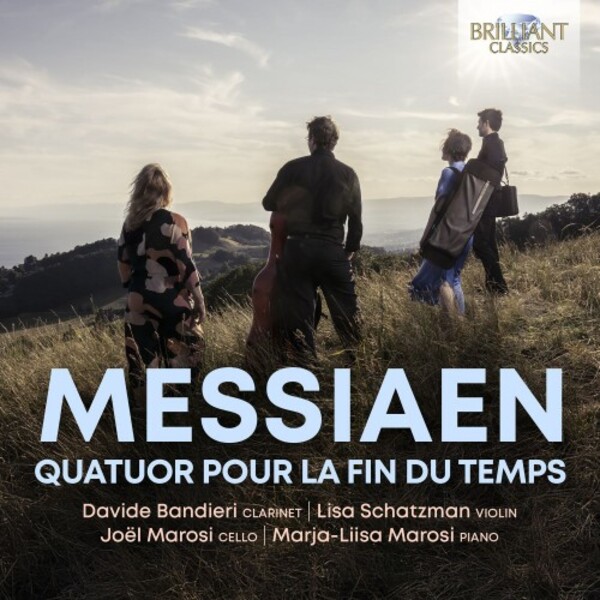
Messiaen - Quatuor pour la fin du temps
£9.45
In stock - available for despatch within 1 working day
Despatch Information
This despatch estimate is based on information from both our own stock and the UK supplier's stock.
If ordering multiple items, we will aim to send everything together so the longest despatch estimate will apply to the complete order.
If you would rather receive certain items more quickly, please place them on a separate order.
If any unexpected delays occur, we will keep you informed of progress via email and not allow other items on the order to be held up.
If you would prefer to receive everything together regardless of any delay, please let us know via email.
Pre-orders will be despatched as close as possible to the release date.
Label: Brilliant Classics
Cat No: 95393
Format: CD
Number of Discs: 1
Genre: Chamber
Release Date: 21st February 2025
Contents
Artists
Davide Bandieri (clarinet)Lisa Schatzman (violin)
Joel Marosi (cello)
Marja-Liisa Marosi (piano)
Works
Quatuor pour la fin du Temps (Quartet for the End of Time)Artists
Davide Bandieri (clarinet)Lisa Schatzman (violin)
Joel Marosi (cello)
Marja-Liisa Marosi (piano)
About
As Messiaen himself explained before the concert, it is the first six verses of the Book of Revelation Chapter 10 that inform the piece as a whole. Starvation in the camp had provoked in him vivid, colourful dreams of the Angel's Rainbow, and the End of Time represented eternity in the face of the mortality confronting the internees. The sensory deprivation he experienced while imprisoned caused (or exacerbated) his synaesthesia, such that his hearing of harmonies and his vision of colours became blended in his mind.
The work’s difficulty is well known; in Görlitz, from musicians already unbalanced by Messiaen’s unconventional rhythms, the composer demanded extreme and unusual instrumental effects: dynamic extremes, unheard-of force and maximum precision. Clarinettist Akoka complained about overly high notes and long phrases; violinist Le Boulaire about wide, inhumanly slow string melodies. But Messiaen’s serenity at the piano instilled confidence, making the impossible possible and raising everything to a higher level.
On a formal level, the eight movements of the Quatuor, linked by symbolic correspondences, reflect the biblical perfection of the number seven: the six days of Creation followed by the day of Rest, which is prolonged into Eternity becoming an eighth of indefectible light and unalterable peace.
‘I composed this quartet to escape from snow, from war, from imprisonment and from myself,' Messiaen said. But the religious silence that enveloped the premiere demonstrated the Quatuor's ability to raise everyone in its first audience along with him, above the barbarity, hunger and cold. Today, hearing this music that is ‘alien to earthly beauty and pervaded by the idea of God’, we perceive its essence ‘beyond Time’, imbued with faith and religiosity.
Error on this page? Let us know here
Need more information on this product? Click here