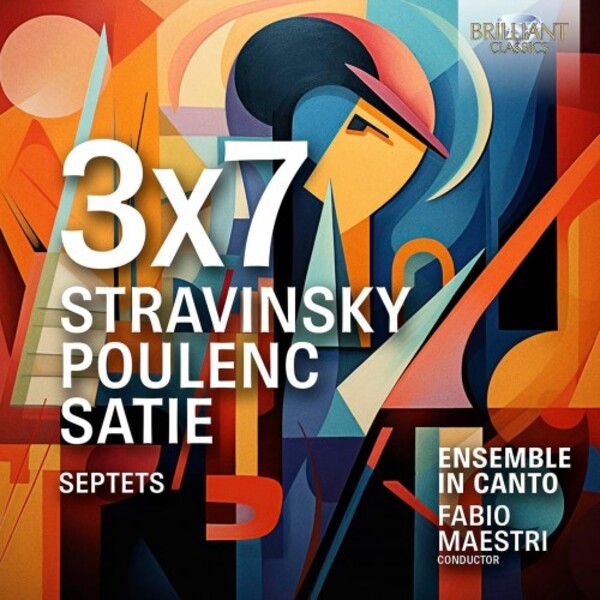
3x7: Stravinsky, Poulenc, Satie - Septets
£9.45
In stock - available for despatch within 1 working day
Despatch Information
This despatch estimate is based on information from both our own stock and the UK supplier's stock.
If ordering multiple items, we will aim to send everything together so the longest despatch estimate will apply to the complete order.
If you would rather receive certain items more quickly, please place them on a separate order.
If any unexpected delays occur, we will keep you informed of progress via email and not allow other items on the order to be held up.
If you would prefer to receive everything together regardless of any delay, please let us know via email.
Pre-orders will be despatched as close as possible to the release date.
Label: Brilliant Classics
Cat No: 96128
Format: CD
Number of Discs: 1
Genre: Chamber
Release Date: 15th November 2024
Contents
Works
Sonata for clarinet and bassoon, FP32aSuite du gendarme incompris, FP20b
Le Piege de Meduse (Sept 'toutes petites danses')
Valses (3) distinguees du precieux degoute
Septet
The Soldier's Tale (L'Histoire du Soldat): Concert Suite
Artists
Ensemble in CantoConductor
Fabio MaestriWorks
Sonata for clarinet and bassoon, FP32aSuite du gendarme incompris, FP20b
Le Piege de Meduse (Sept 'toutes petites danses')
Valses (3) distinguees du precieux degoute
Septet
The Soldier's Tale (L'Histoire du Soldat): Concert Suite
Artists
Ensemble in CantoConductor
Fabio MaestriAbout
In 1921 Francis Poulenc and his mentor Erik Satie each contributed to a théâtre bouffe show with Le Gendarme incompris and Le Piège de Méduse, respectively.
These two works actively sought provocation and scandal, with incredibly surreal plots and nonsense scenarios. Poulenc used his incidental music as the basis for a four-section Suite for a seven-strong ‘small orchestra’.
Satie, meanwhile, reused his seven Toutes Petites Danses for piano, arranging them for the same seven-instrument ensemble as Poulenc. Satie’s Trois Valses distinguées du précieux dégoûté are strongly connected to Le Piège.
They are a merciless portrait of a highly refined dandy, easily recognisable as Ravel, who had recently written some waltzes (the Valses nobles et sentimentales) of his own. Poulenc’s Sonata for clarinet and bassoon takes full advantage of the timbral qualities of the two woodwind instruments (the same used by Stravinsky in L’Histoire) and fits perfectly into the climate that led to Cocteau’s rappel à l’ordre (‘return to order’) and the end of the Parisian avant-garde’s most revolutionary and experimental period.
Many years later Stravinsky, having emigrated to the USA, composed one of his most important works from his late period (having embraced serialism): the Septet. As well as a sophisticated piece of musical arithmetic and a work of exemplary compositional rigour, it also demonstrates masterful symmetry, not least in its new seven-instrument ensemble which ‘balances’ the piano between three strings and three wind instruments – a choice far removed from the scoring of its direct counterpart, L’Histoire – bringing the programme full circle.
Error on this page? Let us know here
Need more information on this product? Click here