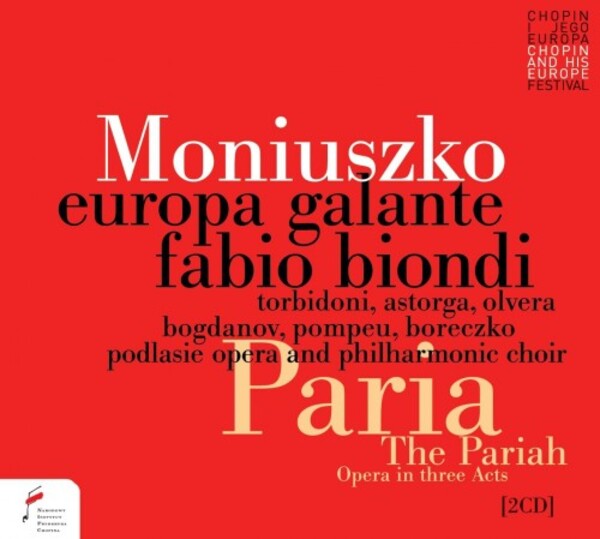
Moniuszko - Paria (The Pariah)
£22.75
In stock - available for despatch within 1 working day
Despatch Information
This despatch estimate is based on information from both our own stock and the UK supplier's stock.
If ordering multiple items, we will aim to send everything together so the longest despatch estimate will apply to the complete order.
If you would rather receive certain items more quickly, please place them on a separate order.
If any unexpected delays occur, we will keep you informed of progress via email and not allow other items on the order to be held up.
If you would prefer to receive everything together regardless of any delay, please let us know via email.
Pre-orders will be despatched as close as possible to the release date.
Label: NIFC (National Institute Frederick Chopin)
Cat No: NIFCCD093-094
Format: CD
Number of Discs: 2
Genre: Opera
Release Date: 25th October 2024
Contents
Artists
Marta Torbidoni (soprano)David Astorga (tenor)
German Olvera (baritone)
Aleksey Bogdanov (bass)
Matheus Pompeu (tenor)
Paulina Boreczko (soprano)
Podlasie Opera and Philharmonic Choir
Europa Galante
Conductor
Fabio BiondiWorks
Paria (The Pariah)Artists
Marta Torbidoni (soprano)David Astorga (tenor)
German Olvera (baritone)
Aleksey Bogdanov (bass)
Matheus Pompeu (tenor)
Paulina Boreczko (soprano)
Podlasie Opera and Philharmonic Choir
Europa Galante
Conductor
Fabio BiondiAbout
By 1859, after successes with Halka and The Raftsman, Moniuszko was highly regarded and received numerous librettos. Returning from Paris, he revisited Paria, collaborating with Jan Chęciński, who was handed Moniuszko's detailed Polish translation of Delavigne's text. Moniuszko's libretto was meticulously prepared, with careful attention to operatic structure, including act and scene divisions, stage directions, and specific performance instructions. He also included practical notes, such as recommending vowel sounds that are easier to sing. This detailed preparation reflects his dedication to the opera's success.
At the 'Chopin and his Europe' festival, Fabio Biondi interprets operas by Moniuszko alongside the operas of his fellow Italians: Bellini, early Verdi and less familiar Donizetti. In that company, Moniuszko seems rather behind the times. But then the whole of our national culture, stifled by the partitioning powers, was behind the times. Moniuszko, however, lifted himself up with his talent. And his Paria proves to be an interesting late Romantic opera of European calibre.
Error on this page? Let us know here
Need more information on this product? Click here