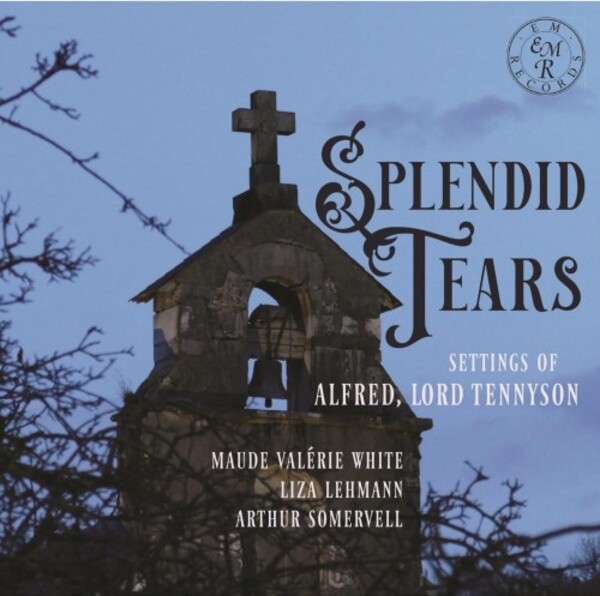
Splendid Tears: Settings of Alfred, Lord Tennyson
£13.78
In stock - available for despatch within 1 working day
Despatch Information
This despatch estimate is based on information from both our own stock and the UK supplier's stock.
If ordering multiple items, we will aim to send everything together so the longest despatch estimate will apply to the complete order.
If you would rather receive certain items more quickly, please place them on a separate order.
If any unexpected delays occur, we will keep you informed of progress via email and not allow other items on the order to be held up.
If you would prefer to receive everything together regardless of any delay, please let us know via email.
Pre-orders will be despatched as close as possible to the release date.
Label: EM Records
Cat No: EMRCD087
Format: CD
Number of Discs: 1
Genre: Vocal/Choral
Release Date: 4th October 2024
Contents
Works
In Memoriam: A Song CycleCycle of Songs from Tennyson's 'Maud'
Songs (4) from Tennyson's 'In Memoriam'
Artists
Brian Thorsett (tenor)Richard Masters (piano)
Works
In Memoriam: A Song CycleCycle of Songs from Tennyson's 'Maud'
Songs (4) from Tennyson's 'In Memoriam'
Artists
Brian Thorsett (tenor)Richard Masters (piano)
About
The poetry is rich in imagery, playing upon the threads of grief, love, redemption, and, perhaps most important to the settings on this disc, inner turmoil. The longer poems present narratives with strongly drawn characters and narrative arcs befitting a song-cycle; it is no wonder that the three composers represented on this disc – Maude White, Arthur Somervell, and Liza Lehmann – could not resist trying their hand at setting portions of two of Tennyson's best-known works, In Memoriam and Maud.
The former poem, In Memoriam, was one of Tennyson's most popular works during his lifetime, exploring the range of emotions that fan out from the central feelings of grief after the passing of a loved one. Tennyson's musings on death, eternity, light, and darkness suited the morbid obsessions of the Victorian era, particularly after the death of Prince Albert and the resulting protracted mourning modelled by Queen Victoria, who was said to adore the poem. Maud is in its own way a similarly brooding work, a tale of a young man's unhealthy obsession with his young neighbour and the ensuing death and madness that results.
Maude White and Liza Lehmann had very different responses to In Memoriam. White works in a tight, perhaps more old- fashioned frame, selecting only four cantos and setting them to rather Mendelssohnian accompaniments. (One can hear echoes of the Fugue in E minor, op.35 no.1, at the end of the fourth song, for example.) Her Four Songs are not a cycle, but rather four individual numbers. Lehmann, fresh off of the triumph of her major vocal quartet In a Persian Garden, was more ambitious. Portions of Tennyson's cantos that have been elided and placed next to one another, sometimes out of order, to create a flowing yet lengthy cycle, with an optional spoken epilogue that seems to speak to Lehmann's dramatic temperament. Lehmann's writing for the piano embraces thunderous octaves and rippling arpeggios, while the singer is given long, emphatic phrases that drive home Tennyson's words so that no neophyte in the audience could possibly miss them.
For his part, Arthur Somervell did much cutting in arranging his musical setting of Maud, but created a successful dramatic flow that maintains the rising hysteria of the original, reaching fever pitch with a setting of "Come into the Garden, Maud" that is much more ecstatic than the more familiar, yet staid, setting by Victorian composer Michael Balfe. The overall effect of the cycle brings to mind the viewing of a dramatisation of the poem through a stereoptican; we see the narrator's father lying dead in the harsh stone hollow; pure young Maud in church; the gently twittering birds of the high hall-garden; and ultimately the departure of the narrator for the Crimean War and hopefully redemption. The music occasionally brings to mind Somervell's primary Germanic models of Schubert and Schumann, but Somervell gives the music a sweep and power that is all his own.
Error on this page? Let us know here
Need more information on this product? Click here