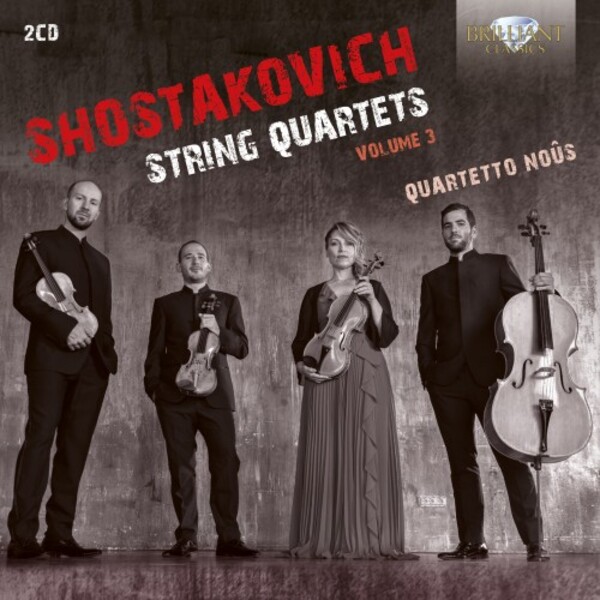
Shostakovich - String Quartets Vol.3
£11.35
In stock - available for despatch within 1 working day
Despatch Information
This despatch estimate is based on information from both our own stock and the UK supplier's stock.
If ordering multiple items, we will aim to send everything together so the longest despatch estimate will apply to the complete order.
If you would rather receive certain items more quickly, please place them on a separate order.
If any unexpected delays occur, we will keep you informed of progress via email and not allow other items on the order to be held up.
If you would prefer to receive everything together regardless of any delay, please let us know via email.
Pre-orders will be despatched as close as possible to the release date.
Label: Brilliant Classics
Cat No: 96422
Format: CD
Number of Discs: 2
Genre: Chamber
Release Date: 11th October 2024
Contents
About
The present album returns almost to the start of Shostakovich’s quartet cycle, with a piece which he claimed (perhaps as a joke) he had originally written as his Second Quartet, before adding a piano part to make it a Piano Quintet with which he could tour and earn much-needed income. At any rate, the Piano Quintet took shape in 1940 and soon became one of his most popular pieces of chamber music: less radical in form and harmony than most of his quartet writing, more extrovert in mood, and more approachable.
The Second Quartet proper was composed in 1944, soon after the Leningrad Symphony which had won the composer international celebrity. Yet the two works exemplify the contrast in style between Shostakovich’s ‘public’ and ‘private’ works. The Waltz of the Second Quartet is one of the most extraordinary examples of his ability to transform instrumental writing into a kind of nightmare factory. Having begun in a determined A major, the Quartet closes in a much more equivocal minor.
The Quartetto Noûs (from the Greek: intellect, mind, but also inspiration, creative capacity), has established itself among the most interesting musical Italian ensembles of its generation, giving captivating interpretations in which the Italian tradition of string-playing merges with other significant European schools such as the Musik Akademie in Basel (where they studied with Rainer Schmidt of the Hagen Quartett), and the Accademia Chigiana in Siena (Gunter Pichler of the Alban Berg Quartett).
Winner, among other awards, of the Farulli Prize in the Abbiati competition, the most prestigious award of Italian music criticism, the Quartetto Noûs demonstrate their individual approach to music spanning the quartet repertoire, and in ambitious contexts such as playing from memory and totally in the dark.
Error on this page? Let us know here
Need more information on this product? Click here