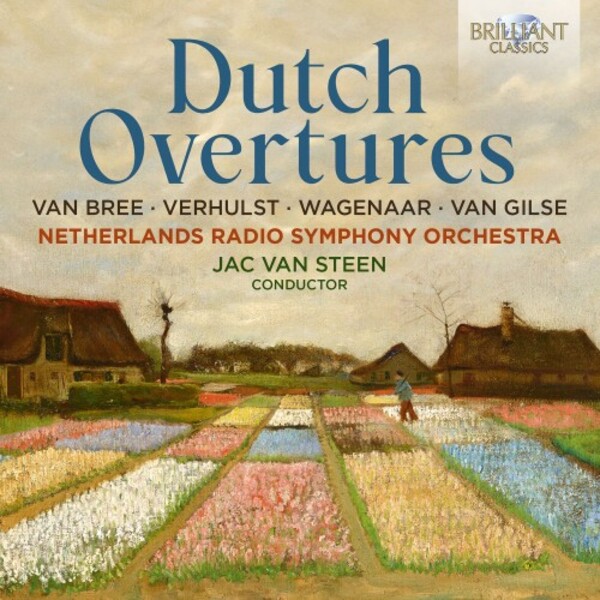
Dutch Overtures: van Bree, Verhulst, Wagenaar, Van Gilse
£9.45
In stock - available for despatch within 1 working day
Despatch Information
This despatch estimate is based on information from both our own stock and the UK supplier's stock.
If ordering multiple items, we will aim to send everything together so the longest despatch estimate will apply to the complete order.
If you would rather receive certain items more quickly, please place them on a separate order.
If any unexpected delays occur, we will keep you informed of progress via email and not allow other items on the order to be held up.
If you would prefer to receive everything together regardless of any delay, please let us know via email.
Pre-orders will be despatched as close as possible to the release date.
Label: Brilliant Classics
Cat No: 96998
Format: CD
Number of Discs: 1
Genre: Orchestral
Release Date: 13th September 2024
Contents
Works
Le BanditConcert Overture in C minor
Overture in C minor, op.3 'Gijsbrecht van Aemstel'
Frithjofs Meerfahrt, op.5 'Frithiof's Sea Voyage'
Fruhlingsgewalt, op.11
Artists
Netherlands Radio Symphony OrchestraConductor
Jac van SteenWorks
Le BanditConcert Overture in C minor
Overture in C minor, op.3 'Gijsbrecht van Aemstel'
Frithjofs Meerfahrt, op.5 'Frithiof's Sea Voyage'
Fruhlingsgewalt, op.11
Artists
Netherlands Radio Symphony OrchestraConductor
Jac van SteenAbout
This explains the success of the overture, a genre that included both the compressed piece of orchestral foreplay to an opera as well as independent pieces. Dutch overtures differ from those of foreign origin in that they tend generally to be mild in tone and lacking in theatricality. The orchestra often has a transparent sound quality, the major sources of inspiration being Weber, Mendelssohn and Boieldieu.
Two fine examples are the two overtures on this album by Johannes van Bree (1801–1857). His output features four independent orchestral overtures, including this one in B minor. Van Bree also composed a number of operas, including Le Bandit, whose Overture contains obvious influences from Weber’s overtures. On the other hand, the Overture in B minor is closer to the French opera overtures of Cherubini and Boieldieu.
Johannes Verhulst (1816–1891) was a friend of Robert and Clara Schumann and his music was acclaimed by Mendelssohn. Judging by his overture to Vondel’s play Gijsbrecht van Aemstel he had listened carefully to Mendelssohn’s ‘Hebrides’ Overture. A series of robust brass chords in a punctuated rhythm also recalls a passage from Schumann’s First Symphony.
When Johan Wagenaar (1862–1941) embarked on his career, the music of his German contemporaries still played an important role in symphonic concerts, and German influence in Wagenaar’s music pervades his entire symphonic oeuvre, which includes a number of overtures. Frithjofs Meerfahrt, op.5, is Wagenaar’s first orchestral work, written around 1884. The later Concert Overture, op.11 ‘Frühlingsgewaltʼ, seems to have been highly coloured by the idyllic nature paintings of Mendelssohn and is striking in its enormous contrasts in tempo and instrumentation.
Even more than Wagenaar, Jan van Gilse (1881–1944) was a product of the conservative faction in German music in the decade around 1900. Shortly before the turn of the century he studied at the conservatory in Cologne under Franz Wüllner, also Willem Mengelberg’s teacher ten years earlier. Van Gilse’s Concert Overture in C minor was written at the end of his conservatory studies. The music begins in a minor key and ends in the major, developing, in Beethovenian terms, from darkness to the light. Despite episodes of turbulence in his music, it always displays an often suppressed but sometimes overt longing for liberation and fulfilment.
Error on this page? Let us know here
Need more information on this product? Click here