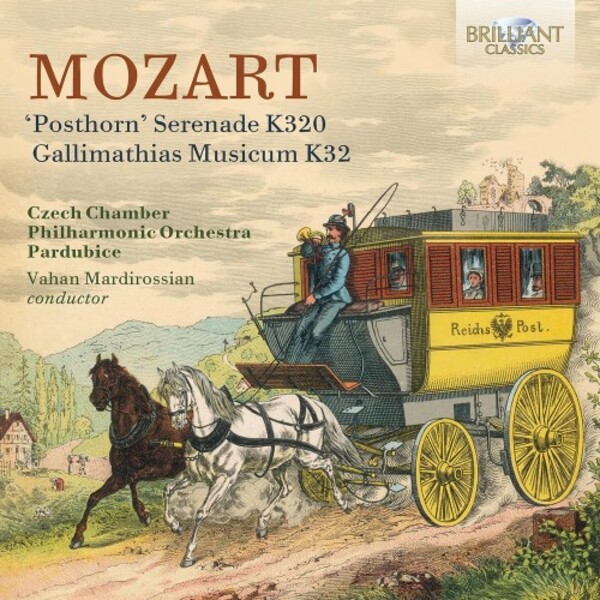
Mozart - Posthorn Serenade, Gallimathias musicum
£9.45
In stock - available for despatch within 1 working day
Despatch Information
This despatch estimate is based on information from both our own stock and the UK supplier's stock.
If ordering multiple items, we will aim to send everything together so the longest despatch estimate will apply to the complete order.
If you would rather receive certain items more quickly, please place them on a separate order.
If any unexpected delays occur, we will keep you informed of progress via email and not allow other items on the order to be held up.
If you would prefer to receive everything together regardless of any delay, please let us know via email.
Pre-orders will be despatched as close as possible to the release date.
Label: Brilliant Classics
Cat No: 97309
Format: CD
Number of Discs: 1
Genre: Orchestral
Release Date: 16th August 2024
Contents
Works
Adagio and Fugue in C minor, K546Gallimathias musicum, K32
Masonic Funeral Music in C minor, K477
Serenade no.9 in D major, K320 'Posthorn'
Artists
Czech Chamber Philharmonic Orchestra PardubiceConductor
Vahan MardirossianWorks
Adagio and Fugue in C minor, K546Gallimathias musicum, K32
Masonic Funeral Music in C minor, K477
Serenade no.9 in D major, K320 'Posthorn'
Artists
Czech Chamber Philharmonic Orchestra PardubiceConductor
Vahan MardirossianAbout
The ‘Posthorn’ Serenade of Mozart has been recorded on many occasions, but perhaps never with such stimulating and contrasted couplings as this new recording from the Czech Chamber Philharmonic Orchestra Pardubice under their Armenian music director, Vahan Mardirossian. These forces recently made an attractive album of Mozart’s ‘Lodron’ divertimenti (97307); now they turn to the grandest of the serenades which Mozart composed while still in the service of the Prince Archbishop of Salzburg.
The ‘Posthorn’ Serenade dates from 1779, and the harmony of its grand introduction immediately belongs to the richly ambivalent world of mature Mozart. Everything here is calculated to entertain, such as the graceful pairs of minuets, and the extensive ‘concertante’ movement featuring a cadenza for solo winds, but beyond that there is a uniquely Mozartian pathos which emerges most strongly in the D minor Andantino.
Little within Mozart’s output could present a stronger contrast than the patchwork of dances and tunes compiled by the 10-year-old composer while convalescing after a serious illness in The Hague. Commissioned for a piece to celebrate the accession of William V as Prince of Orange, he produced this 17-movement Gallimathias musicum. By turn, the album then makes a characteristically Mozartian shift to the grave tread of the Masonic Funeral Music composed in memory of the composer’s Masonic brothers in 1785.
No less imposing in its way is the Fugue in C minor which Mozart originally wrote for two pianos in December 1783. Rescoring it for strings in June 1788, he added a stern and prefatory Adagio. Known as the Adagio and Fugue, K546, this has been recorded by forces ranging from string quartet to full symphony orchestra; the Czech Chamber Philharmonic Orchestra presents a compelling middle way.
Error on this page? Let us know here
Need more information on this product? Click here