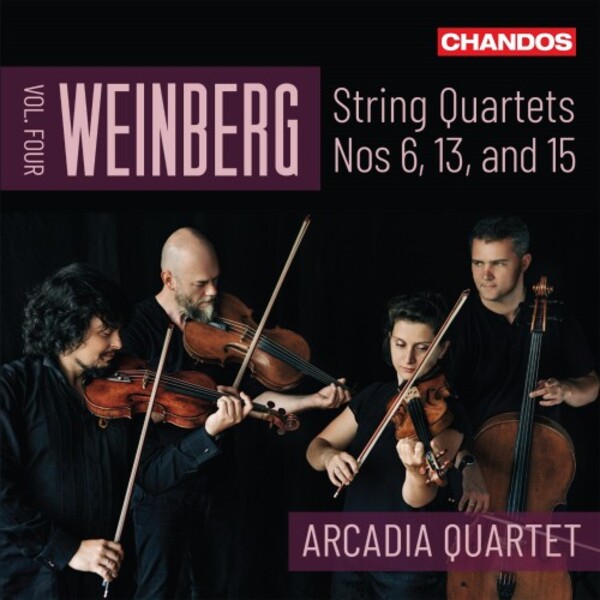
Weinberg - String Quartets Vol.4
£15.15 £12.88
save £2.27 (15%)
special offer ending 01/01/2026
In stock - available for despatch within 1 working day
Despatch Information
This despatch estimate is based on information from both our own stock and the UK supplier's stock.
If ordering multiple items, we will aim to send everything together so the longest despatch estimate will apply to the complete order.
If you would rather receive certain items more quickly, please place them on a separate order.
If any unexpected delays occur, we will keep you informed of progress via email and not allow other items on the order to be held up.
If you would prefer to receive everything together regardless of any delay, please let us know via email.
Pre-orders will be despatched as close as possible to the release date.
Label: Chandos
Cat No: CHAN20281
Format: CD
Number of Discs: 1
Genre: Chamber
Release Date: 19th July 2024
Contents
Works
String Quartet no.6 in E minor, op.35String Quartet no.13, op.118
String Quartet no.15, op.124
Artists
Arcadia QuartetWorks
String Quartet no.6 in E minor, op.35String Quartet no.13, op.118
String Quartet no.15, op.124
Artists
Arcadia QuartetAbout
Quartet no.6 was composed in 1946 in Bïkovo, a town some twenty miles from the south-eastern perimeter of Moscow. Weinberg dedicated it to his friend Georgiy Sviridov, whom he had met in Shostakovich’s circle. The Quartet is a summit of his early achievements, and its musical language is strikingly advanced in relation to traditional Soviet works in the genre. It was banned by the authorities, and as a result, Weinberg wrote no more quartets until after the death of his mentor Shostakovich, in 1975. String Quartet no.13 was composed in 1977 and dedicated to the Borodin Quartet. Like Shostakovich’s Thirteenth Quartet, written seven years earlier, it comprises a single movement lasting some fourteen or fifteen minutes, making it the shortest of all Weinberg’s quartets. String Quartet no.15, from 1979, is in many respects the most radically conceived of all Weinberg’s quartets – certainly its nine-movement design suggests so. In expressive terms, too, it is one of the most elusive. The movements carry no titles or expressive directions, and, as in the case of his previous two quartets, Weinberg confines himself to metronome indications, avoiding all specification of character.
Reviews
 In this fourth instalment of Weinberg string quartets, the Arcadia Quartet tellingly juxtapose one of his greatest works with two of his later and, in one instance, most radical such pieces. ... The Arcadia go a long way to conveying the essence of what could seem oblique or even intractable, enhanced with sound of demonstrable realism and abetted by David Fanning’s authoritative notes. Two thirds of the way through, this has emerged as a formidable cycle. Richard Whitehouse
Error on this page? Let us know here
Need more information on this product? Click here