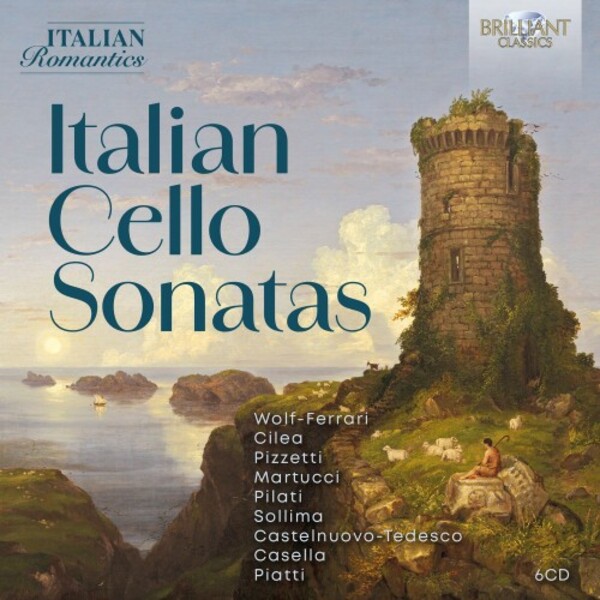
Italian Cello Sonatas
£21.80 £18.53
save £3.27 (15%)
special offer ending 01/01/2026
In stock - available for despatch within 1 working day
Despatch Information
This despatch estimate is based on information from both our own stock and the UK supplier's stock.
If ordering multiple items, we will aim to send everything together so the longest despatch estimate will apply to the complete order.
If you would rather receive certain items more quickly, please place them on a separate order.
If any unexpected delays occur, we will keep you informed of progress via email and not allow other items on the order to be held up.
If you would prefer to receive everything together regardless of any delay, please let us know via email.
Pre-orders will be despatched as close as possible to the release date.
Label: Brilliant Classics
Cat No: 97278
Format: CD
Number of Discs: 6
Genre: Chamber
Release Date: 7th June 2024
Contents
Works
Cello Sonata no.1 in C minor, op.8Cello Sonata no.2 in C major, op.45
Notturno
Tarantella, op.54
Cello Sonata, op.50
Cello Sonata in D major, op.38
Cello Sonata in F sharp minor, op.52
Melodia for violin and piano (trans. Martucci for cello and piano)
Pezzi (3), op.69
Romanze (2), op.72
Cello Sonata no.1 in C major, op.28
Cello Sonata no.2 in D major, op.29
Cello Sonata no.3 in F major, op.30
Cello Sonata no.4 in G major, op.31 'Idillica'
Cello Sonata no.5 in A minor, op.32
Cello Sonata no.6 in E minor, op.33
Cello Sonata in A minor
Cello Sonata in F major
Cello Sonata
Cello Sonata in G major, op.30
Artists
Amedeo Cicchese (cello)Lamberto Curtoni (cello)
Andrea Favalessa (cello)
Roberto Trainini (cello)
Massimiliano Ferrati (piano)
Giovanni Doria Miglietta (piano)
Barbara Panzarella (piano)
Maria Semararo (piano)
Works
Cello Sonata no.1 in C minor, op.8Cello Sonata no.2 in C major, op.45
Notturno
Tarantella, op.54
Cello Sonata, op.50
Cello Sonata in D major, op.38
Cello Sonata in F sharp minor, op.52
Melodia for violin and piano (trans. Martucci for cello and piano)
Pezzi (3), op.69
Romanze (2), op.72
Cello Sonata no.1 in C major, op.28
Cello Sonata no.2 in D major, op.29
Cello Sonata no.3 in F major, op.30
Cello Sonata no.4 in G major, op.31 'Idillica'
Cello Sonata no.5 in A minor, op.32
Cello Sonata no.6 in E minor, op.33
Cello Sonata in A minor
Cello Sonata in F major
Cello Sonata
Cello Sonata in G major, op.30
Artists
Amedeo Cicchese (cello)Lamberto Curtoni (cello)
Andrea Favalessa (cello)
Roberto Trainini (cello)
Massimiliano Ferrati (piano)
Giovanni Doria Miglietta (piano)
Barbara Panzarella (piano)
Maria Semararo (piano)
About
By the time of the ‘Ottocento’ (19th century), opera was the dominant force in Italian musical culture, with bel canto composers such as Rossini and Donizetti creating a public appetite for opera that eclipsed achievements by Italy’s musical sons in other genres. Some of these composers who focused their energies instead on instrumental music, swimming against the operatic tide, remained in their native land, while others found a home (or were forced to find one) abroad.
Giuseppe Martucci (1856-1909) is one who stayed. A gifted pianist, he bypassed the operatic path and wrote music with a kind of fluent synthesis of Italian lyricism and German, dialectic approach to form that reached an early peak in his Cello Sonata of 1880. Yet Martucci, as a teacher of composition in Bologna and then Naples, urged the teenaged Alfredo Casella (1883-1947) to study abroad. Casella’s father was a cellist and his mother a pianist. Several other close relatives were cellists, and his godfather was Alfredo Piatti. It makes sense therefore that, returning from his studies in Paris with Gabriel Fauré, he would unite cello and piano with a thorough grasp of their contrasting idioms.
Ildebrando Pizzetti (1880-1968) is among the few composers in this set whose entire career centred in Italy, and he wrote a substantial body of instrumental music. While Respighi may be the composer most associated outside Italy with Mussolini’s fascist regime, he received no state commissions – unlike both Casella and Pizzetti. Many Jewish Italians such as Mario Castelnuovo-Tedesco (1895-1968), on the other hand, would end up exiled on the other side of the world (Hollywood in his case), but before the war Castelnuovo-Tedesco succeeded in reinventing an essentially Romantic model (of both form and harmony) for his own time with his Cello Sonata, op.50, of 1928. From seven years earlier, Pizzetti’s Sonata of 1921 is a more gloomy, even tortured affair.
The Cello Sonata of Francesco Cilea (1866-1950), while unmistakably cast as an ‘operatic’ work from its opening solo, features a protagonist scarcely burdened by the existential angst to be found in comparable works from northern Europe. But then, like most of the above sonatas, it is a youthful composition, written in 1888 before hits such as La Gioconda established Cilea at the forefront of the verismo movement. Like Cilea, Ermanno Wolf-Ferrari (1876–1948) is known for his operas (in his case, comic operas), but unlike Cilea’s cello sonata, Wolf-Ferrari’s Opus 30 dates from the final three years of his life and belongs to a mature output of instrumental music that is recently being recovered from the shadow of his operatic achievements.
In their different ways, Cilea, Pizzetti, Casella and Wolf-Ferrari all defy a separation of instrumental and vocal writing into opposing abstract and evocative poles, their cello sonatas capitalising, as did countless others, on associations of the cello’s timbre with singers and its capacity for heroism in the hands of a new generation of celebrity soloists. Foremost among those celebrated virtuoso cellists was Alfredo Piatti (1822-1901), aforementioned godfather to Casella. While he produced many trifles and showpieces to display his artistry to his adoring public in London, he was most proud of the set of six sonatas included in this set. He wrote them over an 11-year period starting in 1885, during the last period of his creative life. Born in the north-Italian city of Bergamo and trained at the conservatoire in Milan, Piatti was another figure who found fame and fortune outside his native country. In 1844 he made his first appearance in the English capital and soon settled there, playing both as a soloist and in one of the first celebrity string quartets.
The Cello Sonata by Mario Pilati (1903-1938) is another product of the fast-moving 1920s, formed in a Romantic tradition but inflected – like the music of Casella, Pizzetti and Castelnuovo-Tedesco – by contemporary trends in impressionism and futurism. From the next generation of composers, the Cello Sonata composed in 1948 by Eliodoro Sollima (1926-2000) fluently incorporates the kind of modal harmonies and cross-rhythms adopted by the likes of Bartók and Janáček from the folk traditions of their own cultures.
Error on this page? Let us know here
Need more information on this product? Click here