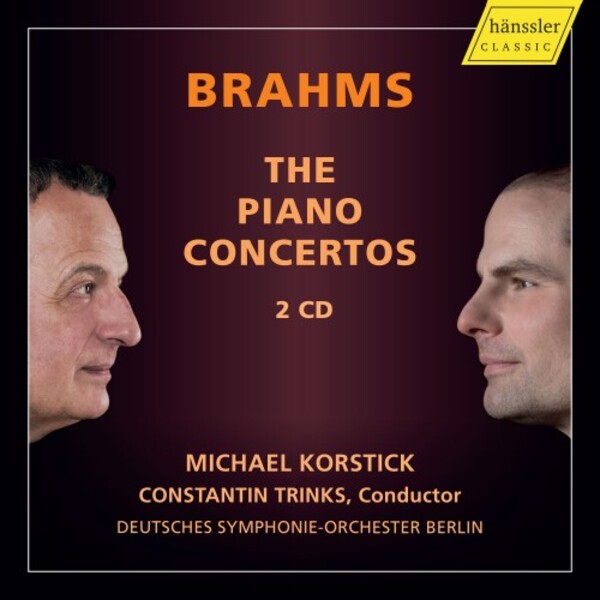
Brahms - The Piano Concertos
£26.55
In stock - available for despatch within 1 working day
Despatch Information
This despatch estimate is based on information from both our own stock and the UK supplier's stock.
If ordering multiple items, we will aim to send everything together so the longest despatch estimate will apply to the complete order.
If you would rather receive certain items more quickly, please place them on a separate order.
If any unexpected delays occur, we will keep you informed of progress via email and not allow other items on the order to be held up.
If you would prefer to receive everything together regardless of any delay, please let us know via email.
Pre-orders will be despatched as close as possible to the release date.
Label: Haenssler Classic
Cat No: HC23082
Format: CD
Number of Discs: 2
Genre: Orchestral
Release Date: 7th June 2024
Contents
Artists
Michael Korstick (piano)Deutsches Symphonie-Orchester Berlin
Conductor
Constantin TrinksWorks
Piano Concerto no.1 in D minor, op.15Piano Concerto no.2 in B flat major, op.83
Artists
Michael Korstick (piano)Deutsches Symphonie-Orchester Berlin
Conductor
Constantin TrinksAbout
When the young Brahms started out searching the limelight in the early 1850s with his first major composition he was facing a musical world torn apart by ideological wars about questions of form, harmony, and the role of programme music. In this decade, two irreconcilable parties emerged, on one side the so-called "conservatives" who centre was the Leipzig Conservatory (founded by Felix Mendelssohn-Bartholdy), with figureheads like Clara Schumann and Joseph Joachim, on the other side the group of self-proclaimed "heralds of the future" led by Franz Liszt and Richard Wagner who would become known as the "Neudeutsche Schule" in 1859, a term coined by Franz Brendel.
Brahms, not even twenty years old, was an ambitious pianist coming from a humble background in Hamburg, and these aesthetic quarrels didn't concern him at all. His official first works, the Piano Sonatas Opus 1 and 2 and the Scherzo, op.4, are with all their individuality somewhat indebted to Beethoven and firmly rooted in classical harmony while only their remarkably compact piano writing offers novel characteristics. To put it simply, the young composer was following his inner voice independently of any currents.
Error on this page? Let us know here
Need more information on this product? Click here