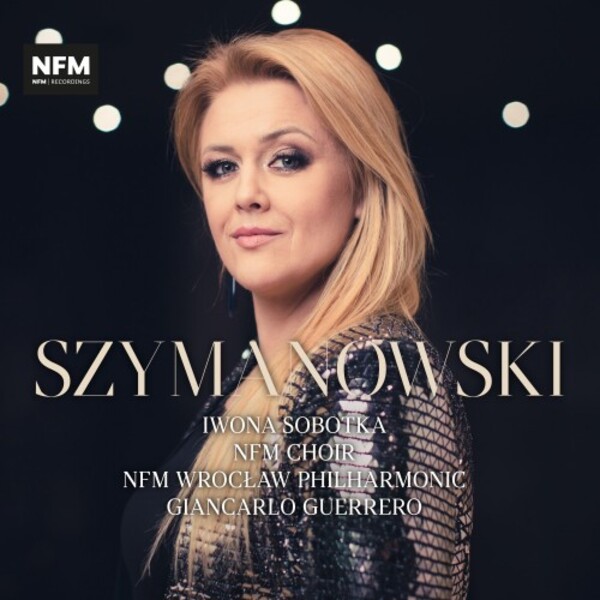
Szymanowski - Symphony no.3, Songs of a Fairy-Tale Princess, Overture
£20.85
In stock - available for despatch within 1 working day
Despatch Information
This despatch estimate is based on information from both our own stock and the UK supplier's stock.
If ordering multiple items, we will aim to send everything together so the longest despatch estimate will apply to the complete order.
If you would rather receive certain items more quickly, please place them on a separate order.
If any unexpected delays occur, we will keep you informed of progress via email and not allow other items on the order to be held up.
If you would prefer to receive everything together regardless of any delay, please let us know via email.
Pre-orders will be despatched as close as possible to the release date.
Label: CD Accord
Cat No: ACD315
Format: CD
Number of Discs: 1
Release Date: 21st June 2024
Contents
Works
Concert Overture, op.12Songs of a Fairy-Tale Princess, op.31
Symphony no.3, op.27 'The Song of the Night'
Artists
Iwona Sobotka (soprano)NFM Choir
NFM Wroclaw Philharmonic
Conductor
Giancarlo GuerreroWorks
Concert Overture, op.12Songs of a Fairy-Tale Princess, op.31
Symphony no.3, op.27 'The Song of the Night'
Artists
Iwona Sobotka (soprano)NFM Choir
NFM Wroclaw Philharmonic
Conductor
Giancarlo GuerreroAbout
An orchestral debut, one of numerous song cycles and finally a short yet massive vocal-instrumental work. Years spanning their dates of inception: twelve. Significantly greater span – between the dates of their premieres, interspersed by greater and lesser historical events, most notably the First World War and both Russian revolutions, along with a series of personal trials and reappraisals of the artist’s spirituality, as well as bad luck and unfavourable circumstances.
What – apart from the author – links these works? Seemingly very little, yet certain common threads can be found. Among them that each of the three works is linked to a degree with some kind of specific literary text. ‘Some kind of’ that is to say different in each instance. Songs of a Fairy Princess is a clear example of a ‘musical setting’.
Symphony no.3 subtitled ‘The Song of the Night’, has at its core the text of a Persian mystic, yet is fundamentally an instrumental work capable of being performed without voices.
What about the Overture? In keeping with the spirit – or manner – of the era, the first version of the work was preceded by a poetic motto from the poem Witeź Włast by Tadeusz Miciński (1873–1918), a close friend of the composer, a cult figure in today’s slang and in yesterday’s stricter definition, a type of ‘magus’, and one of the leaders of Polish modernism at the turn of the 20th century. In the climactic point of his verse Miciński wrote about ‘the proud and brutal triumph’ of his hero, not quite the legitimate descendant of a Nietzschean superman. Later – like in Mahler’s Symphony no.1 – the motto disappeared. Perhaps just as well. Triumph? Undoubtedly, even infused with pride, however bloody sacrificial stones or any brutality are nowhere to be found in the sunlit E major of the Overture.
Error on this page? Let us know here
Need more information on this product? Click here