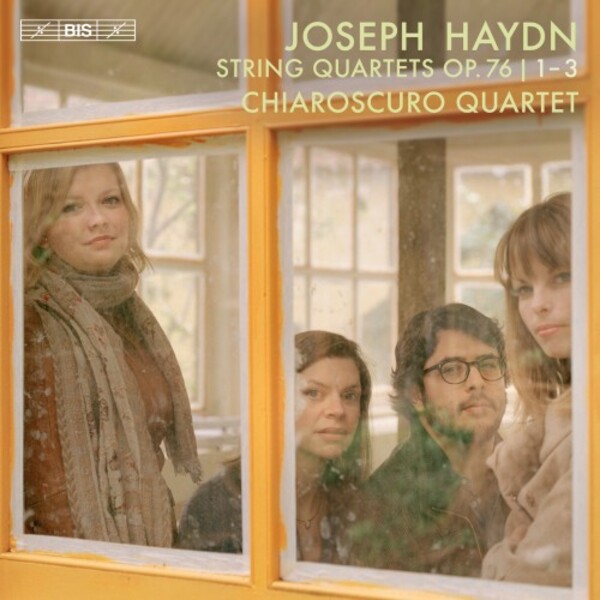
Haydn - String Quartets op.76 nos 1-3
£14.73 £11.78
save £2.95 (20%)
special offer ending 25/01/2026
In stock - available for despatch within 1 working day
Despatch Information
This despatch estimate is based on information from both our own stock and the UK supplier's stock.
If ordering multiple items, we will aim to send everything together so the longest despatch estimate will apply to the complete order.
If you would rather receive certain items more quickly, please place them on a separate order.
If any unexpected delays occur, we will keep you informed of progress via email and not allow other items on the order to be held up.
If you would prefer to receive everything together regardless of any delay, please let us know via email.
Pre-orders will be despatched as close as possible to the release date.
Label: BIS
Cat No: BIS2348
Format: Hybrid SACD
Number of Discs: 1
Genre: Chamber
Release Date: 29th May 2020
Contents
Works
String Quartets (6), op.76Artists
Chiaroscuro QuartetWorks
String Quartets (6), op.76Artists
Chiaroscuro QuartetAbout
Sound/Video
Paused
-
1String Quartet in G major, op.76 no.1: 1. Allegro con spirito
-
2String Quartet in G major, op.76 no.1: 2. Adagio sostenuto
-
3String Quartet in G major, op.76 no.1: 3. Menuetto. Presto
-
4String Quartet in G major, op.76 no.1: 4. Finale. Allegro ma non troppo
-
5String Quartet in D minor, op.76 no.2 ‘Fifths’: 1. Allegro
-
6String Quartet in D minor, op.76 no.2 ‘Fifths’: 2. Andante o più tosto allegretto
-
7String Quartet in D minor, op.76 no.2 ‘Fifths’: 3. Menuetto. Allegro
-
8String Quartet in D minor, op.76 no.2 ‘Fifths’: 4. Finale. Vivace assai
-
9String Quartet in C major, op.76 no.3 ‘Emperor’: 1. Allegro
-
10String Quartet in C major, op.76 no.3 ‘Emperor’: 2. Poco adagio. Cantabile
-
11String Quartet in C major, op.76 no.3 ‘Emperor’: 3. Menuetto. Allegro
-
12String Quartet in C major, op.76 no.3 ‘Emperor’: 4. Finale. Presto
Europadisc Review
Proceedings get off to a cracking start with the G major Quartet, its opening chords a call to attention, followed immediately by a prime example of the popular mood Haydn had honed to perfection in London. With both halves of the first movement repeated, the lovely, unmarked sotto voce on the second time round at bar 195 serves as ideal preparation for the mezza voce of the following Adagio sostenuto. Here, the offbeat violin 1 notes in the first episode are lovingly shaped, as are the duetting violins before the third statement of the theme. In the Chiaroscuro’s hands, the latter stages of this heavenly movement anticipate the hymnlike intensity of Beethoven’s late quartets.
The Presto Minuet flies past like a breeze, an unmistakably Haydnesque version of the Beethovenian scherzo being developed at the same time, while the Trio with its violin solo against pizzicato accompaniment dances delightfully, and Ibragimova has great fun with some teasingly lengthened upbeats.
The Finale begins unexpectedly in G minor; its closing theme, with the accent thrown onto second-beat syncopations, is perfectly weighted here, while the tension in the harmonically tumultuous development is superbly shaped and built to create maximum impact at the disarmingly soft emergence of the tonic major. The double-joke of the throw-away ending, in Haydn’s most appealingly vernacular vein, caps a superb performance that brings out all the colour of this brilliantly orchestrated quartet.
Known by the popular nickname ‘Fifths’ after its bald opening motif, the D minor Quartet opens with a first movement of ghostly, otherworldly feel that is far removed both from Mozart’s minor-key pathos and Haydn’s own ‘Sturm und Drang’ phase. The mood is particularly haunting when the instruments are in close imitation in the development section. There are some nicely judged rhetorical pauses, and once again all repeats intact; the way the players charge to the movement’s close helps to maintain the overall feeling of urgency.
The serenade-like Andante brings much-needed relaxation, and even the minor-key central section has to it a gentle hue, while Ibragimova’s virtuoso violin embellishments of the main theme’s return are have a wryness to them that will unfailingly raise a smile. The octave canon of the so-called ‘witches’ Minuet’ is followed by an earthily rustic Trio where the players dig in without overstepping the bounds of period-style propriety. In the finale, Ibragimova once again teases the listener (in perfect Haydnesque style) with the paused notes that end the first phrase, and the movement as a whole moves along with a powerful inevitability leading to the sunlit major-key peroration.
The C major ‘Emperor’ Quartet opens with a sense of perfect equilibrium, with salonesque refinement and popular jauntiness held in ideal balance until the eruption of E major musette-style drones in the development section. Once again, the observance of the second-half repeat reaps huge rewards in terms of overall formal balance as well as the excitement of the più presto marking for the coda’s reprise.
The second-movement variations on Haydn’s Kaiserlied that give the Quartet its nickname are pure joy here, not too reverential, with the first part of the Poco adagio indication taken into due consideration, and the cantabile marking evident in a manifestly singing style. With each member of the quartet in turn given the main theme for a variation, this is perhaps the purest embodiment of chamber-music democracy, building to the exquisitely poised and scored textures of the final variation. The Minuet sees another return to Haydn’s best ‘popular’ style, while the A minor Trio seems to glance far ahead into the 19th century with its pre-echoes of Schumann’s great Piano Quintet.
Once again Haydn takes the listener unawares with a Finale that for the most part occupies the tonic minor, and once again the Chiaroscuro players deliver playing of huge passion and stylishness, the bubbling triplets of the cello and viola (later to be tossed between the violins) injecting real urgency into the proceedings. There’s a Mendelssohnian fleetness to the development section and, notwithstanding the eventual, initially tentative emergence of the tonic major, the players keep up momentum right to the end. In doing so, they seem to be looking forward keenly to the continuation of the project, including the glorious ‘Sunrise’ Quartet (no.4). And, like them, we can’t wait!
This is surely now a top choice among discs of these much-recorded works for those wanting excellent modern sound, musical insight and faultless stylishness. Haydn playing at its very best: what more could one ask for? The splendid recording, produced by the ever-reliable Andrew Keener, the presentation, and even the ‘Habsburg yellow’ decor on the cover photo, all add to the sense that this is a very special disc indeed.
Coincidentally, this week also sees the release Ibragimova in the role of soloist, a stunningly intense account of Shostakovich’s two violin concertos on the Hyperion label, with the ‘Evgeny Svetlanov’ State Academic Symphony Orchestra of Russia under Vladimir Jurowski providing unmistakably slavic-flavoured support. Ibragimova and Jurowski seem to have an instinctive rapport in all their collaborations, and this disc, a strong contender for those wanting both these works on a single disc, will certainly further delight the violinist’s many admirers.
Error on this page? Let us know here
Need more information on this product? Click here