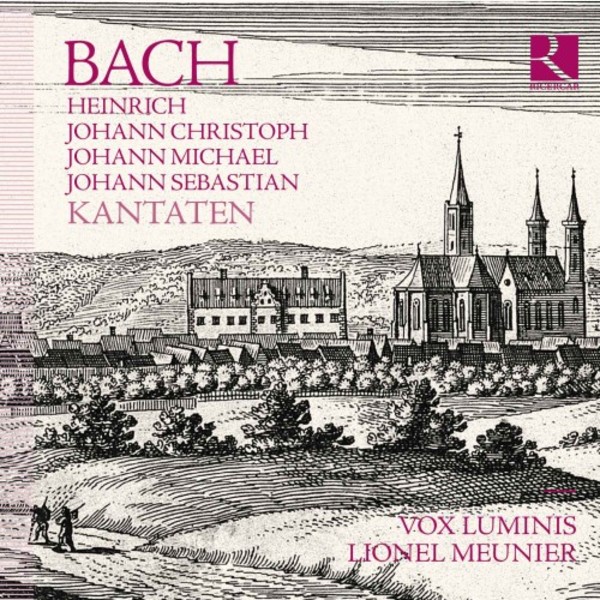
Bach Family - Cantatas
£14.73
In stock - available for despatch within 1 working day
Despatch Information
This despatch estimate is based on information from both our own stock and the UK supplier's stock.
If ordering multiple items, we will aim to send everything together so the longest despatch estimate will apply to the complete order.
If you would rather receive certain items more quickly, please place them on a separate order.
If any unexpected delays occur, we will keep you informed of progress via email and not allow other items on the order to be held up.
If you would prefer to receive everything together regardless of any delay, please let us know via email.
Pre-orders will be despatched as close as possible to the release date.
Label: Ricercar
Cat No: RIC401
Format: CD
Number of Discs: 1
Genre: Vocal/Choral
Release Date: 14th June 2019
Contents
Works
Ich danke dir, GottDie Furcht des Herren
Es erhub sich ein Streit 'Kantate zum Michaelissonntag'
Herr, wende dich und sei mir gnadig
Ach, bleib bei uns, Herr Jesu Christ
Herr, der Konig freuet sich
Cantata BWV4 'Christ lag in todes Banden' (Easter Cantata)
Artists
Vox LuminisConductor
Lionel MeunierWorks
Ich danke dir, GottDie Furcht des Herren
Es erhub sich ein Streit 'Kantate zum Michaelissonntag'
Herr, wende dich und sei mir gnadig
Ach, bleib bei uns, Herr Jesu Christ
Herr, der Konig freuet sich
Cantata BWV4 'Christ lag in todes Banden' (Easter Cantata)
Artists
Vox LuminisConductor
Lionel MeunierAbout
Sound/Video
Paused
-
1JM Bach - Ach bleib bei uns, Herr Jesu Christ
-
2JC Bach - Die Furcht des Herren
-
3H Bach - Ich danke dir Gott
-
4JM Bach - Herr, der Konig freuet sich
-
5JC Bach - Herr, wende dich und sei mir gnadig
-
6JS Bach - Christ lag in Todesbanden, BWV 4: I. Sinfonia
-
7JS Bach - Christ lag in Todesbanden, BWV 4: II. Christ lag in Todesbanden
-
8JS Bach - Christ lag in Todesbanden, BWV 4: III. Den Tod niemand zwingen kunnt
-
9JS Bach - Christ lag in Todesbanden, BWV 4: IV. Jesus Christus, Gottes Sohn
-
10JS Bach - Christ lag in Todesbanden, BWV 4: V. Es war ein wunderlicher Krieg
-
11JS Bach - Christ lag in Todesbanden, BWV 4: VI. Hie ist das rechte Osterlamm
-
12JS Bach - Christ lag in Todesbanden, BWV 4: VII. So feiern wir das hohe Fest
-
13JS Bach - Christ lag in Todesbanden, BWV 4: VIII. Wie essen und wir leben wohl
-
14JC Bach - Es erhub sich ein Streit
Europadisc Review
While the music of Bach’s sons is now much better known than a generation ago, the compositions of his forebears is still underappreciated, but Vox Luminis’s immensely stylish and engaging performances should help to change that. The earliest music here is by JS Bach’s great-uncle, Heinrich Bach (1615-1692): the sacred concerto Ich danke dir Gott, with five-part vocal ensemble and five-part strings (two violins, two violas and continuo). Homophonic and virtuosic antiphonal passages alternate most effectively, making one regret that so few examples from Heinrich’s pen survive.
The other two ‘early Bachs’ represented here are Heinrich’s sons Johann Christoph (1642-1703) and Johann Michael (1648-1694). The latter contributes two sacred concertos: the uplifting Herr, der König freuet sich is written for double-choir and five strings, and abounds in Venetian-style polychoral effects on a small scale. Ach bleib bei uns, Herr Jesu Christ, which opens the disc, is written for just four voices, but with six-part strings (three violins, two violas and violone), and the exchanges between the top two violins in the introductory sinfonia at times bring to mind Monteverdi.
Impressive as these works are, they are overshadowed by the music of Johann Michael’s brother, Johann Christoph. Described by JS Bach himself as ‘a profound composer’, he is the most outstanding composer of the early Bachs, and three of his works feature here, all of high quality. Die Furcht des Herren is scored for double-chorus, strings and continuo, while Herr, wende dich und sei mir gnädig is for solo and ripieno quartets of singers plus strings and continuo. This is deeply absorbing music, and its expressive profundity and rich sonorities are enhanced (as is all the music on the disc) by the inclusion of a substantial organ continuo in the Thomas organ in the church of Notre-Dame de la Nativité in Gedinne, Belgium. Most immediately impressive of all, however, is the St Michael’s Day cantata Es erhub sich ein Streit, for double choir plus 3 violins, 3 violas, bassoon, four trumpets, timpani and continuo! Trumpets and drums thrillingly accompany the vocal forces to give a vivid portrayal of the struggle of good (the angels) to overcome (the dragon, as personification of the devil). Like Herr, wende dich, this is an expansive work with plenteous examples of the invention and the expressive and harmonic daring that JS Bach evidently admired.
Before that rousing conclusion, Vox Luminis perform what may well be JS Bach’s earliest cantata, the Eastertide Christ lag in Todesbanden, BWV 4, probably written in Arnstadt before Bach took up his post as organist at St Blasius’s Chucrh in Mühlhausen. Bach himself thought highly enough of this archaically-styled work to revive it in his later years at Leipzig, but here Vox Luminis perform it in its earliest scoring with just two violins, two violas and continuo for support (i.e. without the later addition of trombones). Even in this early form, the work makes a huge impression, with clear debts to the composer’s predecessors (as there are to Johann Pachelbel), but already exhibiting some notably Sebastianesque thumbprints like the symmetrical formal plan and the sheer quality of inventiveness. Thanks to the context of the rest of the disc, the listener can appreciate the boldness of this 20-minute cantata (the longest single work on the disc) even more fully than usual. Fine solo and duet work, a marvellously (but not over-) blended choral sound and brilliantly executed instrumental parts all make this a disc to treasure: an immensely rewarding exploration of the Bachian hinterland, and quite possibly Vox Luminis’s finest disc to date.
Reviews
 These Bach family cantatas capture what Vox Luminis does best. When singing as an ensemble, the vocalists draw us into intricate works with a pellucid yet robust timbre. Details register with ringing clarity, whether as motifs passing between soloists, as the creamy blend of voice with instrument in a shared line, or as the joint of breath to explore a rhetorical pause. ... In this project Vox Luminis celebrtaes not just the Bach family, but the power of music-making itself. Berta Joncus (Recording of the Month)
 One of the key differences between Vox Luminis and many other such ensembles (particularly those of the pioneering generation of the 1980s and ’90s) is how homogeneity is challenged as the default priority. As you can hear in [Johann] Christoph’s dialogus Die Furcht des Herren, there is no shortage of purple-rich blend and supreme tuning but, alongside, singers and instrumentalists are expected to react, copy or dissent, according to both the text and the abstract direction of the music. The strong identities within the ensemble allow for new lyrical dimensions to emerge here... It’s deeply affecting. ... [In Christ lag in Todesbanden] Lionel Meunier lets the music breathe, always resisting forced or mannered declamation. ... Throughout this beguiling programme, Vox Luminis inhabit a world from which you’ll need to drag yourself away. Jonathan Freeman-Attwood
 With its transparent, flexible, indeed luminous sound, [Vox Luminis] is rather different from English ensembles. ... Some of these pieces have been recorded before, notably by Musica Antiqua Cologne (DG Archiv), but whereas those performances under Reinhard Goebel were instrumentally led, these new ones are vocally led and sound freshly minted. Nicholas Kenyon
Error on this page? Let us know here
Need more information on this product? Click here