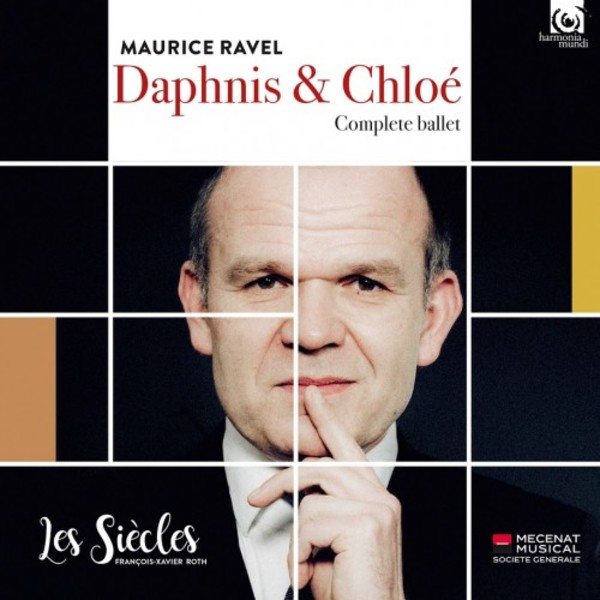
Ravel - Daphnis & Chloe: complete ballet
£16.10
In stock - available for despatch within 1 working day
Despatch Information
This despatch estimate is based on information from both our own stock and the UK supplier's stock.
If ordering multiple items, we will aim to send everything together so the longest despatch estimate will apply to the complete order.
If you would rather receive certain items more quickly, please place them on a separate order.
If any unexpected delays occur, we will keep you informed of progress via email and not allow other items on the order to be held up.
If you would prefer to receive everything together regardless of any delay, please let us know via email.
Pre-orders will be despatched as close as possible to the release date.
Label: Harmonia Mundi
Cat No: HMM905280
Format: CD
Number of Discs: 1
Genre: Ballet
Release Date: 31st March 2017
Contents
Artists
Marion Ralincourt (flute)Ensemble Aedes
Les Siecles
Conductor
Francois-Xavier RothWorks
Daphnis et ChloeArtists
Marion Ralincourt (flute)Ensemble Aedes
Les Siecles
Conductor
Francois-Xavier RothAbout
The orchestral forces are the largest Ravel ever employed and he adds a mixed chorus that sometimes hums and sometimes sings. As we have come to expect, François-Xavier Roth, in his début for Harmonia Mundi, has gone through Ravel's much-amended score with a fine-tooth comb and subsequently showed himself capable, in a ‘historically informed’ performance, of reproducing with the musicians of Les Siècles all the transparency and stylistic precision one could wish for in Ravel’s masterpiece.
"Daphnis et Chloé is part of the large-scale project we embarked on with Les Siècles in 2009: the odyssey of the Ballets Russes. To celebrate the centenary of that incredible artistic adventure, we wanted to reconstruct the Parisian orchestra that premiered these works in order to restore their original colours... As with each work of the Ballets Russes that we’ve played so far, we noticed just how remarkably the instruments of Ravel’s time, those French-built instruments typical of the early twentieth century, do justice to this music and make it meaningful!" - François-Xavier Roth
Sound/Video
Paused
-
1Maurice Ravel: Daphnis et Chloé, M. 57, Acte I, Première partie - Introduction
-
2Maurice Ravel: Daphnis et Chloé, M. 57, Acte I, Première partie - Danse religieuse
-
3Maurice Ravel: Daphnis et Chloé, M. 57, Acte I, Première partie - Vif, Danse générale
-
4Maurice Ravel: Daphnis et Chloé, M. 57, Acte I, Première partie - Danse grotesque de Dorcon, Scène
-
5Maurice Ravel: Daphnis et Chloé, M. 57, Acte I, Première partie - Danse légère et gracieuse de Daphnis
-
6Maurice Ravel: Daphnis et Chloé, M. 57, Acte I, Première partie - Lent [devant le groupe radieux que forment Daphnis et Chloé enlacés]
-
7Maurice Ravel: Daphnis et Chloé, M. 57, Acte I, Première partie - Danse de Lycéion
-
8Maurice Ravel: Daphnis et Chloé, M. 57, Acte I, Première partie - Scène [Les Pirates]
-
9Maurice Ravel: Daphnis et Chloé, M. 57, Acte I, Première partie - Nocturne [Une lumière irréelle enveloppe le paysage]
-
10Maurice Ravel: Daphnis et Chloé, M. 57, Acte I, Première partie - Danse lente et mystérieuse des Nymphes
-
11Maurice Ravel: Daphnis et Chloé, M. 57, Acte I, Première partie - Interlude
-
12Maurice Ravel: Daphnis et Chloé, M. 57, Acte I, Deuxième partie - Introduction, Danse guerrière
-
13Maurice Ravel: Daphnis et Chloé, M. 57, Acte I, Deuxième partie - Danse suppliante de Chloé
-
14Maurice Ravel: Daphnis et Chloé, M. 57, Acte I, Deuxième partie - Lent [Soudain l'atmosphère semble chargée d'éléments insolites]
-
15Maurice Ravel: Daphnis et Chloé, M. 57, Acte I, Troisième partie - Lever du jour, Scène
-
16Maurice Ravel: Daphnis et Chloé, M. 57, Acte I, Troisième partie - Pantomime [Daphnis & Chloé miment l'aventure de Pan et de Syrinx]
-
17Maurice Ravel: Daphnis et Chloé, M. 57, Acte I, Troisième partie - Très lent [Chloé figure par sa danse les accents de la flûte]
-
18Maurice Ravel: Daphnis et Chloé, M. 57, Acte I, Troisième partie - Chloé tombe dans les bras de Daphnis
-
19Maurice Ravel: Daphnis et Chloé, M. 57, Acte I, Troisième partie - Animé, Danse générale
Europadisc Review
Roth and Ravel expert Jean-François Monnard went through the score afresh, weeding out some tenacious printing errors over a century after the works première. There are no big surprises, but the beauty and transparency of this account, especially in the more lyrical dance episodes and also in the bacchanal-like closing Danse générale, place this recording in a select band of modern recordings to set alongside such classics as Monteux (with the LSO) and Munch (Boston Symphony Orchestra). At moments, there are even hints of a Munch-like élan, if not sheer abandon. But the character of the music throughout, from the gently erotic dances to the raw humour of Dorcon’s Danse grotesque and the thrill of the pirates’ Danse guerrière, is exceptionally vivid. There is little need to consult a synopsis when the tone-painting and realisation is this tangible, and the supernatural moments (for example when the spirits of Pan intervene to rescue Chloé, track 16) have a spine-tingling immediacy.
The instrumental playing throughout is pure joy, not least the principal flute of Marion Ralincourt, and the truly French horns led by Fabien Norbert. Lower woodwind may lack the sheer pungency of Cluytens’s famous account with the Paris Conservatoire Orchestra, but the timbres of the instruments will still be startlingly refreshing for most listeners. So, too, will the 32-voice chorus, somewhat smaller than on most other recordings, and recorded fairly close (only just ‘behind the scene’ in many cases), adding an unexpectedly human element to this mythical tale. The emotional pain of the voices-only Interlude following Chloé’s abduction (track 11) has rarely been as perfectly captured.
Above all, Roth and his players succeed more than any of the competition in recapturing Ravel’s own vision of ancient Greece, which assuredly owed more to French artists of the late 18th century than to choreographer Michel Fokine’s more authentically classical view based on Longus’s original romance. It was a vision that made the genesis of this ‘symphonie chorégraphique’ more than usually turbulent for the composer, and he would surely be delighted with this performance.
Thankfully, there is no hint of audience noise, nor indeed of the apparently patchwork nature of the recording (taken from several performances). The sound is pleasingly immediate, the presentation first-class. Those who have been following Les Siècles’ traversal of the early 20th-century Ballets russes repertoire will snap this up without hesitation; so should others, for among modern accounts and even alongside the classics mentioned above it is utterly distinctive, ravishingly beautiful, and ardently compelling.
Reviews
 Roth’s recording is taken from Les Siècles’s European tour last year though, unlike the performance of Daphnis they gave at last year’s Aldeburgh festival, it does include the wordless chorus (provided by Ensemble Aedes) that Ravel made optional in concert. With the strings playing on gut and wind instruments from the early years of the 20th century (all detailed in the sleeve notes), the sound is fabulously transparent; every detail of the woodwind and brass articulation, so minutely specified by Ravel, is clear. Roth’s approach may be too cool for some tastes – there’s not much Dionysian abandon about it – but, as a guide to one of the most brilliant of all orchestral scores, it’s hard to fault. Andrew Clements
 We don’t know what the orchestral sound was like at its 1912 Paris
premiere…but many listeners will be familiar with the 1959 LSO recording
by the original conductor, Pierre Monteux, long a treasure of the Decca
catalogue. Comparisons are instructive. Les Siècles’ French-built
woodwind and brass instruments from the early 20th century (documented
in the booklet) provide greater tonal sweetness, especially the Selmer
trumpets, which don’t dominate textures as much as the incisive LSO
brass. Lean gut strings achieve feathery lightness. ... François-Xavier
Roth teases a much more expansive opening than Monteux, a slow burn
leading to an ecstatic first choral entry. He is often more languorous,
the performance nearly four minutes slower than the Decca account.
However, Roth attacks the ‘Danse guerrière’ with more vim and also whips
up a faster bacchanalian finale. With fine choral contributions from
the Ensemble Aedes, this new recording is highly recommended. Mark Pullinger
We don’t know what the orchestral sound was like at its 1912 Paris
premiere…but many listeners will be familiar with the 1959 LSO recording
by the original conductor, Pierre Monteux, long a treasure of the Decca
catalogue. Comparisons are instructive. Les Siècles’ French-built
woodwind and brass instruments from the early 20th century (documented
in the booklet) provide greater tonal sweetness, especially the Selmer
trumpets, which don’t dominate textures as much as the incisive LSO
brass. Lean gut strings achieve feathery lightness. ... François-Xavier
Roth teases a much more expansive opening than Monteux, a slow burn
leading to an ecstatic first choral entry. He is often more languorous,
the performance nearly four minutes slower than the Decca account.
However, Roth attacks the ‘Danse guerrière’ with more vim and also whips
up a faster bacchanalian finale. With fine choral contributions from
the Ensemble Aedes, this new recording is highly recommended. Mark Pullinger

Error on this page? Let us know here
Need more information on this product? Click here