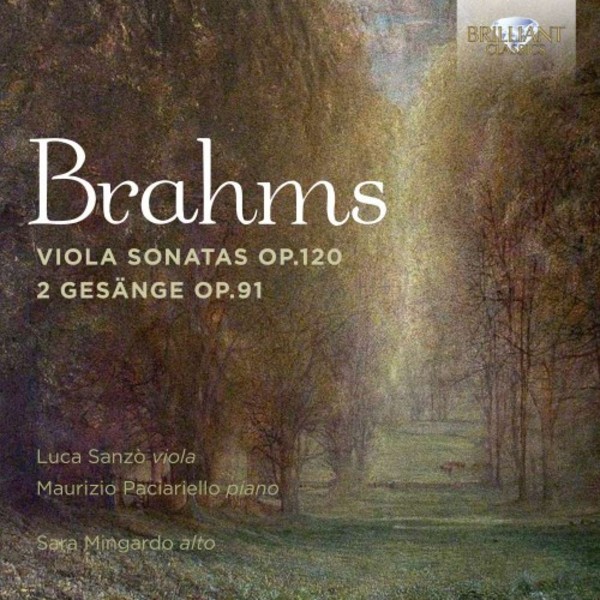
Brahms - Viola Sonatas, 2 Gesange op.91
£9.45
In stock - available for despatch within 1 working day
Despatch Information
This despatch estimate is based on information from both our own stock and the UK supplier's stock.
If ordering multiple items, we will aim to send everything together so the longest despatch estimate will apply to the complete order.
If you would rather receive certain items more quickly, please place them on a separate order.
If any unexpected delays occur, we will keep you informed of progress via email and not allow other items on the order to be held up.
If you would prefer to receive everything together regardless of any delay, please let us know via email.
Pre-orders will be despatched as close as possible to the release date.
Label: Brilliant Classics
Cat No: 95281
Format: CD
Number of Discs: 1
Release Date: 7th October 2016
Contents
Works
Gesange (2), op.91 for alto, viola and pianoViola Sonata no.1 in F minor, op.120 no.1 (transc. from clarinet sonata)
Viola Sonata no.2 in E flat major, op.120 no.2 (transc. from clarinet sonata)
Artists
Luca Sanzo (viola)Maurizio Paciariello (piano)
Sara Mingardo (alto)
Works
Gesange (2), op.91 for alto, viola and pianoViola Sonata no.1 in F minor, op.120 no.1 (transc. from clarinet sonata)
Viola Sonata no.2 in E flat major, op.120 no.2 (transc. from clarinet sonata)
Artists
Luca Sanzo (viola)Maurizio Paciariello (piano)
Sara Mingardo (alto)
About
Melancholy is perhaps inevitably the major key of both sonatas – Brahms had been drawn to express autumnal loneliness even 40 years before – but they are not gloomy works, and are built with undimmed ingenuity as masterfully organic structures in which the usual contrast of first and second themes is forsaken for the kind of continuous variation which Arnold Schoenberg could justly and admiringly describe as ‘musical prose’.
With her unforgettably resonant and plangent contralto, Sara Mingardo has graced the world’s stages and halls, espeically in Baroque repertoire as a regular collaborator with Rinaldo Alessandrini and Concerto Italiano. Here she joins Luca Sanzò and Maurizio Paciariello in the two songs which were first published a decade prior to the viola sonata, though the Geistliches Wiegenlied (Sacred Lullaby) dates back to 1863, as a wedding present for his friend Joseph Joachim to the soprano Amalie Weiss. He added Gestillte Sehnsucht (Satisfied Longing) 20 years later when the couple were about to divorce, causing a rift between the two musicians that would only be healed in 1887 after Brahms had written his last orchestral work, the Double Concerto, with parts for Joachim’s violin and a semi‐autobiographical one for the cello. Both songs speak of yearning – erotic and spiritual – with an almost Straussian intensity of expression.
Error on this page? Let us know here
Need more information on this product? Click here