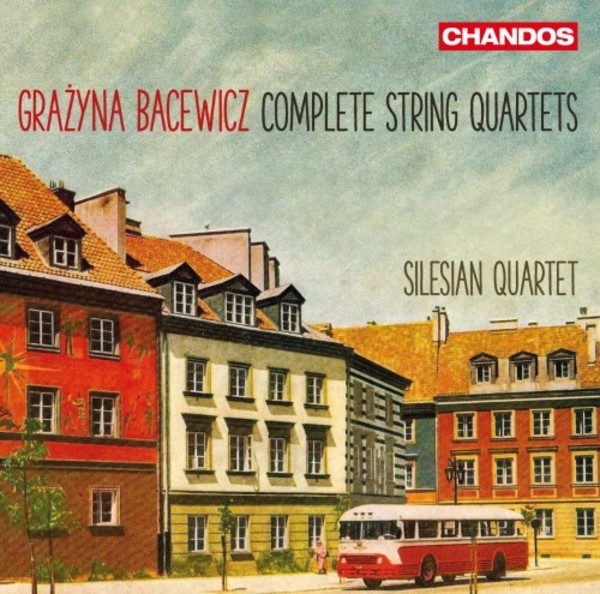
Bacewicz - Complete String Quartets
£15.15 £12.88
save £2.27 (15%)
special offer ending 01/01/2026
Usually available for despatch within 3-5 working days
Despatch Information
This despatch estimate is based on information from both our own stock and the UK supplier's stock.
If ordering multiple items, we will aim to send everything together so the longest despatch estimate will apply to the complete order.
If you would rather receive certain items more quickly, please place them on a separate order.
If any unexpected delays occur, we will keep you informed of progress via email and not allow other items on the order to be held up.
If you would prefer to receive everything together regardless of any delay, please let us know via email.
Pre-orders will be despatched as close as possible to the release date.
Label: Chandos
Cat No: CHAN109042
Format: CD
Number of Discs: 2
Genre: Chamber
Release Date: 1st July 2016
Contents
Works
String Quartet no.1String Quartet no.2
String Quartet no.3
String Quartet no.4
String Quartet no.5
String Quartet no.6
String Quartet no.7
Artists
Silesian QuartetWorks
String Quartet no.1String Quartet no.2
String Quartet no.3
String Quartet no.4
String Quartet no.5
String Quartet no.6
String Quartet no.7
Artists
Silesian QuartetAbout
The life of Bacewicz, like that of better-known colleagues such as Witold Lutosławski and Andrzej Panufnik, was conditioned by the political and military events of her time. Her works reflected not only these traumas but also the shifting stylistic currents of twentieth-century music.
Her seven string quartets, written between 1938 and 1965, are a telling barometer of these changes. The also stand as a timeline of her resolute compositional outlook and as a testament to her profound understanding of string instruments. String Quartet No.1 comes after her studies in Paris in 1932–35 with Nadia Boulanger (composition), André Touret, and Carl Flesch (both violin), No.2 was written in Warsaw during World War II, Nos 3, 4, and 5 date from the post-war decade, a time of socialist-realist cultural upheavals, while Nos 6 and 7 were composed during the avant-garde musical explosion that thrust Polish music onto the world stage in the late 1950s.
Reviews
 Less than a year after the Lutosławski Quartet released its recording of Grażyna Bacewicz’s seven quartets on Naxos, here is a rival from the Silesian Quartet at a similar price. Which to choose? The most striking difference is speed: the Silesians knock minutes off the run times of each quartet compared to the Lutosławskis, and their default playing style is springy and fleet-footed, bringing out the idiomatic nature of Bacewicz’s string writing. ... In the end the Lutosławskis’ weightier reading is perhaps the more satisfying, but the Silesians’ version is highly persuasive too, and it is good to hear these works interpreted differently. Erica Jeal
 Unlike Naxos, and an earlier cycle from the Amar Corde Quartet on the Polish label Acte Préalable, Chandos presents the quartets in chronological order, and there’s no better path into Bacewicz’s sound world. Take that path, and it’s difficult not to be convinced that these works constitute an achievement worthy to stand alongside the quartet cycles of Tippett, Britten, Shostakovich and Bartók. ... With at least three recorded cycles, Bacewicz’s quartets haven’t been as badly served as some and it’s wonderful to have the choice of two very different recent recordings. Nonetheless, the assurance, insight and finish of this particular set make it feel like a landmark – an assertion of this music’s place at the heart of the 20th-century quartet repertoire, where it surely belongs. The Silesian Quartet play it like it’s Beethoven. There’s no point-making, just a shared commitment to letting Bacewicz speak. And that’s something profoundly worth hearing. Richard Bratby (Recording of the Month)
 Following the Lutosławski Quartet's excellent Naxos set, these lived-in readings by the older generation Silesian Quartet deepen and enrich our understanding. ... The Silesian handle these works with precision and elan: a tremendous achievement. Helen Wallace

Error on this page? Let us know here
Need more information on this product? Click here