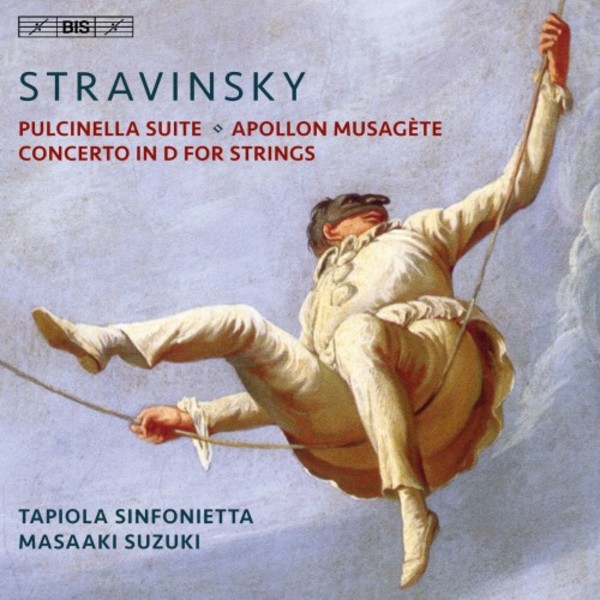
Stravinsky - Pulcinella Suite, Apollon musagete, Concerto in D
£14.73 £11.78
save £2.95 (20%)
special offer ending 25/01/2026
In stock - available for despatch within 1 working day
Despatch Information
This despatch estimate is based on information from both our own stock and the UK supplier's stock.
If ordering multiple items, we will aim to send everything together so the longest despatch estimate will apply to the complete order.
If you would rather receive certain items more quickly, please place them on a separate order.
If any unexpected delays occur, we will keep you informed of progress via email and not allow other items on the order to be held up.
If you would prefer to receive everything together regardless of any delay, please let us know via email.
Pre-orders will be despatched as close as possible to the release date.
Label: BIS
Cat No: BIS2211
Format: Hybrid SACD
Number of Discs: 1
Genre: Orchestral
Release Date: 27th May 2016
Contents
Artists
Tapiola SinfoniettaConductor
Masaaki SuzukiWorks
Apollon musagete (1947 version)Concerto in D major for strings, 'Basler'
Pulcinella Suite
Artists
Tapiola SinfoniettaConductor
Masaaki SuzukiAbout
The disc begins with the music for Pulcinella – here in the concert suite devised by the composer – which Stravinsky later described as ‘the epiphany through which the whole of my later work became possible’. For this adaptation of an early eighteenth-century commedia dell'arte libretto, he based his score on existing music, initially ascribed to Pergolesi although material by other baroque composers is also included. Stravinsky’s approach is never that of a faithful transcriber, however: in Pulcinella the material is slanted harmonically, rhythmically and texturally in a manner reminiscent of cubism – and it was indeed Picasso who provided the decor and costumes for the ballet's first performance.
The neoclassical (or neo-baroque) spirit remained a vital part of Stravinsky’s compositional armoury for a long time, and also informs the other two works presented here. The formal design of the Concerto in D, composed some 25 years after Pulcinella, pays homage to the baroque concerti grossi of Vivaldi and Bach, while the score for the ballet Apollon musagète (also known as Apollo) contains references to French music from the seventeenth and eighteenth centuries.
Sound/Video
Paused
-
1Pulcinella Suite - I. Overture: Sinfonia
-
2Pulcinella Suite - II. Serenata
-
3Pulcinella Suite - III. Scherzino, Allegro, Andantino
-
4Pulcinella Suite - IV. Tarantella
-
5Pulcinella Suite - V. Toccata
-
6Pulcinella Suite - VI. Gavotta, Variation No. 1, Variation No. 2
-
7Pulcinella Suite - VII. Vivo
-
8Pulcinella Suite - VIII. Minuetto
-
9Pulcinella Suite - IX. Finale
-
10Apollon Musagète, Tableau I - Tableau I: Prologue: The Birth Of Apollo
-
11Apollon Musagète, Tableau II - Tableau II: Apollo's Variation
-
12Apollon Musagète, Tableau II - Tableau II: Pas D'action: Apollo And The Muses
-
13Apollon Musagète, Tableau II - Tableau II: Variation Of Calliope
-
14Apollon Musagète, Tableau II - Tableau II: Variation Of Polymnia
-
15Apollon Musagète, Tableau II - Tableau II: Variation Of Terpsichore
-
16Apollon Musagète, Tableau II - Tableau II: Variation Of Apollo
-
17Apollon Musagète, Tableau II - Tableau II: Pas De Deux: Apollo And Terpsichore
-
18Apollon Musagète, Tableau II - Tableau II: Coda: Apollo And The Muses
-
19Apollon Musagète, Tableau II - Tableau II: Apotheosis: Apollo And The Muses
-
20Concerto For Strings In D Major - I. Vivace
-
21Concerto For Strings In D Major - II. Arioso: Andantino
-
22Concerto For Strings In D Major - III. Rondo: Allegro
Europadisc Review
The commedia dell’arte-themed Pulcinella Suite (1924, revised 1949), the classical ballet Apollon musagète (1928, rev. 1947) and the neo-baroque Concerto in D for string orchestra (1946), make an attractive and surprisingly effective programme, an airy counterweight to the ubiquitous Firebird-Petrushka-Rite of Spring trilogy. Where in the Dionysian ‘Big Three’ it is the wind and percussion that tend to dominate, in this later trio it is the Apollonian strings that increasingly come to the fore – indeed, exclusively so in Apollon musagète and the Concerto. Suzuki’s immersion in Bach and the wider baroque means that he knows just how to make the stringed instruments breathe as well as dance, so that the balletic qualities of all three works are constantly felt.
In Pulcinella Suzuki brings out the humour without the ironic edginess that characterises Stravinsky’s own dry, deadpan and starkly monochrome recording, instead emphasising the playful exuberance of the Tarantella, Toccata, Vivo and Finale movements. But he also gets the graceful lyricism of the Serenata and Gavotte, aided by some superb solo playing and a recording that brings out every nuance and strand of Stravinsky’s scoring. Indeed, there can seldom have been a disc of this popular work that sounds quite so gloriously yet unexaggeratedly colourful, so naturally good-humoured. It’s an immensely stylish reading, but at the same time wonderfully ebullient and extrovert.
Just as impressive are the subtler delights of Apollon musagète, where the richness of the scoring never obscures the music’s essentially ethereal nature. It’s remarkable just how much light and shade, how much sheer colour Suzuki and his Finnish orchestra bring to this elegant strings-only score. In his excellent booklet notes, Arnold Whittall emphasises the music’s ‘expansively elevated’ style, in a work that Stravinsky himself declared was the closest he had come to true tragedy in his music. In this particular unfolding, the story of Apollo and the three Muses has a classical poise and beauty of line, but also a tremendous underlying animative quality, which bursts to the surface most obviously in the Coda (track 18). And just listen to the extraordinary delicacy of the Pas de deux for Apollo and the Muse Terpsichore (track 17) to hear these musicians at their most rapt. If any single account can persuade you of Apollon musagète’s greatness, this is the one; it is as lithe an account of this ‘Cinderella’ work as there has ever been.
The disc ends with a compelling account of the Concerto in D, originally composed for Paul Sacher’s Basel Chamber Orchestra. This is Stravinsky’s homage to and affectionate critique of the concerto grosso of Vivaldi and JS Bach, and Suzuki presents a vibrant reading, with all the Stravinskian quirks – the harmonic clashes, the exaggerated swells on individual chords, the biting rhythms – deliciously brought out. He also taps into the darker undertones in the central Arioso (which opens with a lovely bell-like tolling from the double bass), and the insistently energetic Rondo third movement brings the work to a thrilling and satisfying close. The whole disc acts as a brilliant advocate for Stravinsky’s neoclassical phase, as well as an outstanding achievement for Suzuki and the Tapiola Sinfonietta.
Reviews
 There’s a baroque sensibility to their performance of the suite from Pulcinella, the ballet Stravinsky crafted early 18th-century scores – Suzuki makes each note count as the individual lines combine and compete, perhaps at the expense of the music’s natural, classical lyricism. And so, while it’s crisp and pleasingly emphatic, there’s a sense that the performance is keeping a lid on the music’s exuberance. Similarly, both Apollon Musagète and the Concerto in D can sound airier and more fluid than this, but in these strings-only mini-masterpieces the Sinfonietta sounds earthy and fiery, and two out of four elements is definitely something to be going on with. Erica Jeal
Error on this page? Let us know here
Need more information on this product? Click here