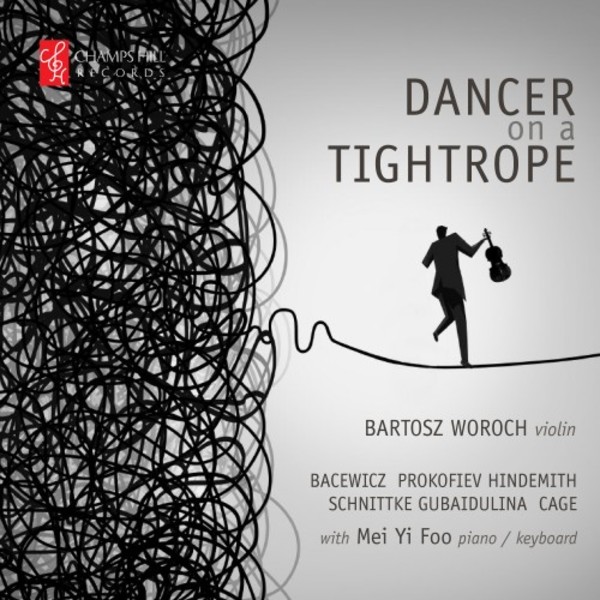
Dancer on a Tightrope
£11.35
Usually available for despatch within 3-5 working days
Despatch Information
This despatch estimate is based on information from both our own stock and the UK supplier's stock.
If ordering multiple items, we will aim to send everything together so the longest despatch estimate will apply to the complete order.
If you would rather receive certain items more quickly, please place them on a separate order.
If any unexpected delays occur, we will keep you informed of progress via email and not allow other items on the order to be held up.
If you would prefer to receive everything together regardless of any delay, please let us know via email.
Pre-orders will be despatched as close as possible to the release date.
Label: Champs Hill Records
Cat No: CHRCD114
Format: CD
Number of Discs: 1
Genre: Chamber
Release Date: 29th April 2016
Contents
Works
Sonata no.2 for solo violinMelodies (6) for violin and keyboard
Dancer on a Tightrope, for violin and piano
Sonata for solo violin, op.31 no.2
Sonata for solo violin in D major, op.115
Fuga for solo violin
Artists
Bartosz Woroch (violin)Mei Yi Foo (piano, keyboard)
Works
Sonata no.2 for solo violinMelodies (6) for violin and keyboard
Dancer on a Tightrope, for violin and piano
Sonata for solo violin, op.31 no.2
Sonata for solo violin in D major, op.115
Fuga for solo violin
Artists
Bartosz Woroch (violin)Mei Yi Foo (piano, keyboard)
About
This 1993 piece represents a break from the confines of everyday life, inevitably associated with risk and danger, using extended techniques for both violin and piano. Not only this piece but the whole recital embraces the desire to take flight, for the exhilaration of movement, of dance, of ecstatic virtuosity.
Grażyna Bacewicz (1909-1969) is a rarity: a Polish female composer whose work has become well known. Her Sonata for Solo Violin is an early work (1929) but is ferocious and Bartosz describes it as ‘full of evil’.
Prokofiev’s Second Sonata for Violin (1947), by contrast, seems to hark back to the previous century with its simple melodies – originally designed for multiple players in unison – and not premiered until after his death in 1959.
John Cage’s Six Melodies (1950) for violin and keyboard instrument uses sparse textures where the violinist is instructed to use no vibrato.
Hindemith’s Sonata for Solo Violin of 1924 is in four sections, described as having been written on the train between Hannover and Frankfurt, with the final section a set of variations on a song by Mozart.
Born in Poznan, Poland, Bartosz studied at the Paderewski Academy of Music in Poznan, the Hochschule der Kunste Berne and with Louise Hopkins at the Guildhall School of Music & Drama, where he is now a professor.
Reviews
 This 20th-century programme from the UK-based Polish violinist Bartosz Woroch is full of intriguing repertoire. It starts with Grażyna Bacewicz’s 1924 Solo Sonata No 2, a fierce and brilliant piece, powerfully played. At its centre is the title track, a 1993 work by Sofia Gubaidulina in which Bartosz’s violin stretches and pirouettes, yearning for flight; underneath, the piano offers a kind of safety net, its strings at first set eerily vibrating from within the instrument using a glass tumbler, then more conventionally played. Mei Yi Foo supplies this and the insistent, disembodied-sounding keyboard part in John Cage’s eerie Six Melodies. … Everything is played with a focused intensity and a sense of risk-taking that make for compulsive listening. Erica Jeal
Error on this page? Let us know here
Need more information on this product? Click here