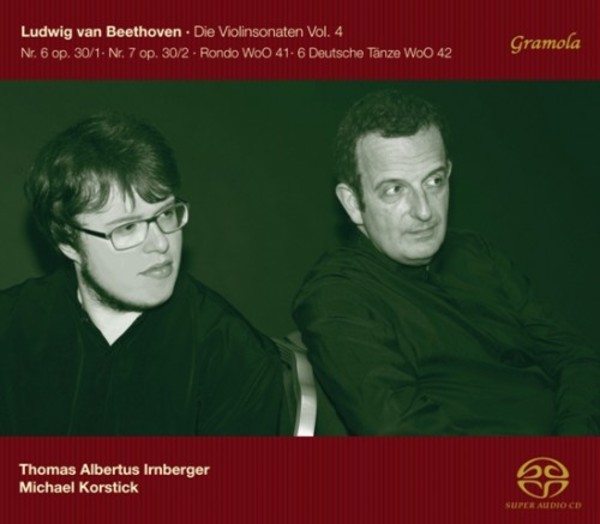
Beethoven - Violin Sonatas Vol.4
£17.05
Usually available for despatch within 3-5 working days
Despatch Information
This despatch estimate is based on information from both our own stock and the UK supplier's stock.
If ordering multiple items, we will aim to send everything together so the longest despatch estimate will apply to the complete order.
If you would rather receive certain items more quickly, please place them on a separate order.
If any unexpected delays occur, we will keep you informed of progress via email and not allow other items on the order to be held up.
If you would prefer to receive everything together regardless of any delay, please let us know via email.
Pre-orders will be despatched as close as possible to the release date.
Label: Gramola
Cat No: 99053
Format: CD
Number of Discs: 1
Genre: Chamber
Release Date: 4th January 2016
Contents
Works
German Dances (6), WoO42Rondo in G major for piano and violin, WoO41
Violin Sonata no.6 in A major, op.30 no.1
Violin Sonata no.7 in C minor, op.30 no.2
Artists
Thomas Albertus Irnberger (violin)Michael Korstick (piano)
Works
German Dances (6), WoO42Rondo in G major for piano and violin, WoO41
Violin Sonata no.6 in A major, op.30 no.1
Violin Sonata no.7 in C minor, op.30 no.2
Artists
Thomas Albertus Irnberger (violin)Michael Korstick (piano)
About
The fourth and final volume of the complete recordings of Ludwig van Beethoven's violin sonatas by Salzburg violinist Thomas Albertus Irnberger with Michael Korstick, piano, focuses on the sonatas op.30/1 and 30/2.
Composed in 1802, the year when he also wrote the 'Heiligenstädter Testament', these works reflect Beethoven's emotional state: on one hand, there is a new affection, professional success and aspiration; on the other hand, his emerging severe hearing defect, threatening his artistic and psychological existence. Ever so different in style, and characterised by heavy mood swings, the sonatas are composed in the keys of A major (No.6, op.30/1) and C minor (No.7, op.30/2).
The Rondo in G major WoO41, and the Six German Dances WoO42, however, were written in 1794/96 and convey ease and almost juvenile cheerfulness – a trait also prevalent in the interpretation of Irnberger and Korstick.
Error on this page? Let us know here
Need more information on this product? Click here